

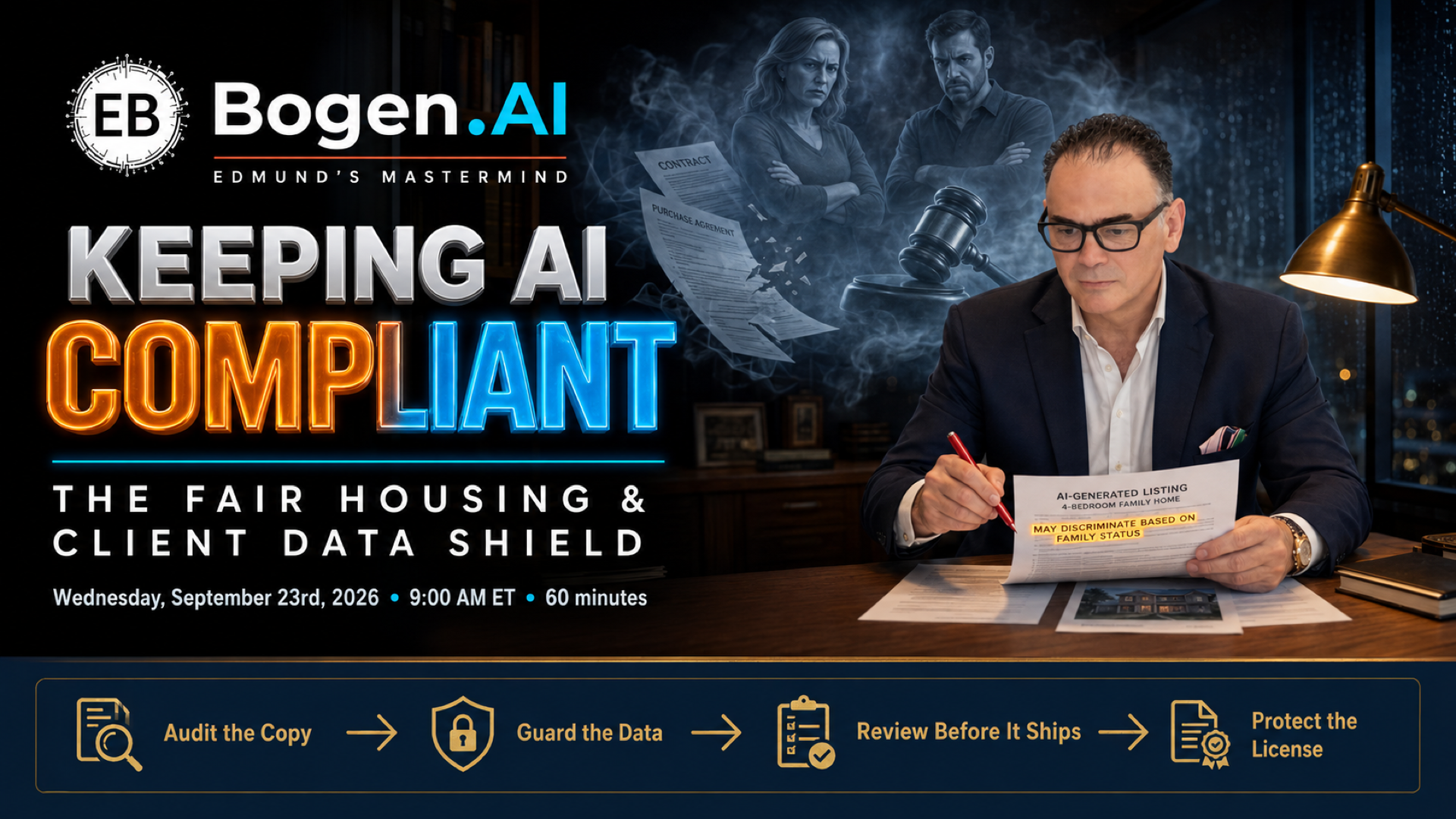
The Fair Housing & Client Data Shield — the complete guide, prepared by Edmund Bogen
AI can draft a listing description in seconds — and it will confidently produce language that a fair-housing regulator reads very differently than a marketer does. This session builds your three-layer shield: audit every AI draft for language that describes people instead of property, keep client information out of AI training data, and run the simple review-document-disclose workflow that makes both habits automatic. Educational session — not legal advice.
The full September 23 live session — the live Fair Housing pop quiz, the two-AI compliance review, and the Green / Yellow / Red rule for client data

While AI writes listing copy for half the industry, the Fair Housing Act hasn't moved an inch — and HUD confirmed in 2024 that it applies to AI-generated advertising exactly as it applies to anything you type yourself. The model will hand you "perfect for young families, walking distance to the church" in flawless marketing prose, because it learned from decades of copy written before anyone audited those phrases. You publish it, you own it.
None of this takes a law degree. It takes three habits, installed once — and this session installs them. Educational session — not legal advice.
We will master 3 systems live, together:
1️⃣ The Fair Housing Firewall — where AI-generated copy drifts into fair-housing risk, the red-flag phrase categories, the property-not-people rewrite rule, and the review prompt to run on every draft before it ships
2️⃣ The Data Line — what never goes into an AI chat, how consumer tiers may train on your inputs while business tiers don't, the settings that matter, and the anonymization habit ("Buyer A, $1.2M budget")
3️⃣ The Compliance Workflow — the protection loop: the human-review gate, the contrastive review prompt, the prompt-draft-final paper trail, simple disclosure language, and the recovery steps when something slips
Watch the RecordingThree layers, one goal — use AI without putting your license or your clients at risk
The shield is not about avoiding AI. It's about using it in a way that protects your clients, your license, and your brokerage — watching what comes out, watching what goes in, and running a loop that makes both automatic.
| Principle | What It Means |
|---|---|
| You own what you publish | HUD confirmed in 2024 that fair-housing rules apply to AI-generated advertising. Responsibility sits with the licensee who publishes — not with the tool. |
| The reasonable-reader test | The measure is what an advertisement indicates to a reasonable reader — not what you intended when you posted it. |
| Property, not people | The working rule from NAR's fair-housing guidance: describe the property and its verifiable features, never the people who might live there. |
| State lists go further | Federal law names seven protected classes; many states and localities add more. Your state's list is the one you work under. |
Educational guide: this material is education, not legal advice — and not a substitute for your broker's policies, your MLS rules, your state license law, or a qualified real-estate attorney.
Audit what comes out of AI — before it publishes
Why AI drifts into risky language. Language models learned to write listing copy from decades of published marketing — including the years when "sell the lifestyle" was standard advice. The model isn't checking the Fair Housing Act; it's predicting what listing copy usually sounds like. That's why the riskiest sentences are often the ones that read most naturally — and why they arrive with total confidence.
| Level | Protected Classes |
|---|---|
| Federal (Fair Housing Act) | Race, color, religion, sex, national origin, familial status, disability. |
| Many states & localities add | Age, marital status, sexual orientation, gender identity, source of income, military status, and more — check your own state's list; it's the one you work under. |
Read every AI draft looking for these six categories. They are signals to rewrite, not an automatic violation list — context matters, and the standard is what the ad suggests to a reasonable reader.
| Category | Sounds Like | The Risk |
|---|---|---|
| Who-it's-for language | "Perfect for young families" · "ideal for empty nesters" · "great starter home for a young couple" | Familial status and age — it tells readers who belongs, and steers who inquires. |
| Safety & neighborhood character | "Safe neighborhood" · "low-crime area" · "desirable area" | Coded language that regulators and courts can read as racial or ethnic steering. |
| Religious landmarks & references | "Walking distance to the church" · "near the temple" · "close-knit faith community" | Religion — signals a preference through geography. |
| Exclusivity & status language | "Exclusive community" · "private enclave" · "prestigious residents" | Implies some people are excluded — the word to keep is the amenity, not the exclusivity. |
| Ability & family-structure assumptions | "Not suitable for wheelchairs" · "perfect for mom and dad" · "walk-up — great exercise" | Disability and familial status — describes bodies and households instead of the home. |
| Ethnicity & national-origin flavoring | "Authentic [any nationality] neighborhood" · "traditional immigrant quarter" | National origin — characterizes the people of an area rather than the property. |
Every red-flag phrase has a compliant twin: swap the assumption about people for a verifiable feature of the property. The feature was always the real selling point.
| Instead Of | Write |
|---|---|
| "Perfect for young families" | "Four bedrooms, fenced backyard, three blocks from Lakeside Elementary" |
| "Safe, quiet neighborhood" | "Cul-de-sac lot on a low-traffic street" |
| "Walking distance to the church" | "Within a mile of parks, shops, and dining" |
| "Exclusive gated community" | "Gated entry, community pool, and tennis courts" |
When a phrase sits in a gray zone, rewrite it anyway — a verifiable feature always sells at least as well — or ask your broker before publishing.
Act as a fair-housing compliance reviewer. Read the listing copy below and flag every word or phrase that describes people rather than property — including who the home is "perfect for," any reference to protected classes (race, color, religion, sex, national origin, familial status, disability, plus my state's additional classes), safety or neighborhood-character coding, religious landmarks, and exclusivity language. For each flag, explain the risk in one sentence and rewrite the phrase to describe a verifiable feature of the property instead. Do not add any new claims I have not given you. Return the fully corrected copy at the end.
The AI review is a second set of eyes, never the last one — a person reads every word before it publishes (System 3).
Watch what goes in — client data never trains a model
The line is simple: your clients trusted you with their identities, finances, and negotiating positions. None of that belongs in an AI chat — on any tier, under any setting. What crosses the line instead is the anonymized shape of the situation.
The same product can handle your words very differently depending on the account it runs under. The pattern below uses ChatGPT as the example; the tier logic is similar across major AI tools, but every product sets its own policy.
| Tier | How Inputs Are Treated |
|---|---|
| Consumer (ChatGPT Free, Plus, and Pro on a personal account) | Conversations may be used to train future models by default. You can opt out: Settings → Data Controls → "Improve the model for everyone" → off. |
| Business (ChatGPT Business/Team, Enterprise, Edu, and the API) | Inputs and outputs are not used for training by default, and a data-processing agreement is available. |
| Every other AI tool | Policies differ and change. Open each tool's data controls, verify the training setting yourself, and re-check after major updates. |
Two cautions: opting out stops future training but does not remove what you already sent — and a toggle checked once is not checked forever. Verify the setting on every account and device you use.
"Buyer A, $1.2M budget, relocating from NY, needs to close before the school year." That one sentence gives the model everything it needs to help — and nothing that identifies anyone. Strip the identity, keep the shape of the situation, and add the real details back later in your own document.
| The Real Detail | What the AI Gets |
|---|---|
| Client's name | "Buyer A" / "my seller" |
| Exact address | "a 4-bed in a gated Boca community" |
| Financial documents | Only the one number the task needs — "budget $1.2M" |
| Personal story | Only the relevant fact — "relocating from NY" |
Know your brokerage's AI-use policy — and if it doesn't have one yet, the worksheet in System 3 is the starting draft to bring to your broker.
Set expectations early. One line in your engagement conversation does it: "We use AI tools to help draft marketing. We never share your personal or financial information with them, and everything is reviewed by our team before it goes out."
Honor the ask. If a client asks that AI not be used on their file, honor it — and note it in the file.
Make it automatic — the repeatable protection loop
Models follow examples better than abstract rules. Put the banned patterns in the prompt itself, and make the model audit its own draft before it hands it back.
Before you write anything: here are examples of language I must never use, because it describes people rather than property — "perfect for young families," "safe neighborhood," "walking distance to the church," "exclusive community." Never characterize who should live in the home, how safe an area is, its demographics, or its religious landmarks. Describe only verifiable features of the property and factual distances to general amenities. Now write the listing description from the details below — and after writing it, audit your own draft against the banned patterns and correct anything that slipped through.
One folder (or one email thread) per listing: the prompt you used, the draft the AI returned, and the final version you published. If a question ever comes, you can show exactly what was generated, what you changed, and when. It takes under a minute per piece — and it ends arguments before they start.
Portions of this description were drafted with AI assistance and reviewed by [Agent Name].
We use AI tools to help prepare marketing materials. Every AI-assisted piece is reviewed by our team before it is shared, and we never provide your personal or financial information to these tools.
Some MLSs and brokerages set their own AI-disclosure rules — check yours and follow the stricter standard.
If a formal complaint or dispute is involved, that is the moment for your broker and a qualified attorney — not for handling it alone.
Write your own office rules here (they save with your browser print/PDF) — then bring the page to your broker.
Keeping AI Compliant — The Fair Housing & Client Data Shield · Prepared by Edmund Bogen
One PDF, everything on this page: the three-layer shield and the standard you're held to, the protected classes, the six red-flag phrase categories with the property-not-people rewrite rule, the fair-housing review prompt, the never-share list, the tier-by-tier data table and the settings that matter, the anonymization habit and safe-input checklist, broker policy and client-consent basics, the five-step protection loop with the contrastive prompt, disclosure language, the recovery steps, and the My Office AI Rules worksheet. Portrait Letter, print-ready.
From the guide's closing page
This guide is educational material prepared for Edmund's Mastermind. It is not legal advice, and it is not a substitute for your broker's policies, your MLS rules, your state license law, or a qualified real-estate attorney.
AI products change their data controls and policies regularly. Open the tool, confirm the setting yourself, and re-check after major updates — treat every screenshot of a settings menu, this guide's included, as a snapshot in time.
| Check | What It Requires |
|---|---|
| High-stakes limit | When a fair-housing complaint, a contract dispute, or a data question is live, the next call is your broker and a qualified attorney — not an AI chat. |
| Currency check | Fair-housing standards, MLS rules, and AI data policies all change. Verify the current requirements before relying on any checklist in this guide. |