


Commission up front, management income for years — prepared by Edmund Bogen
Commission income stops at closing. Management income doesn't. This session builds the second line: how to prove a property can legally be rented nightly before anyone writes an offer, how to model what it really earns and really costs, and how to turn the buyer you just closed into a managed property that pays you every month. Every Airbnb policy quoted here was read on Airbnb's own pages; every rule is a question to put to your broker, your attorney and the municipality.
Commission income stops the day you close. Management income doesn't. Airbnb reported 148.3 million nights booked in the second quarter of 2026, up 10% year over year, at an average daily rate of $184 — and its own co-host page observes that co-hosts "typically charge 15–25% for ongoing support." The agent who sold the property is the natural person to run it.
The risk isn't finding a property. It's selling one that can't legally be rented — or signing an owner into an agreement that breaches their loan.
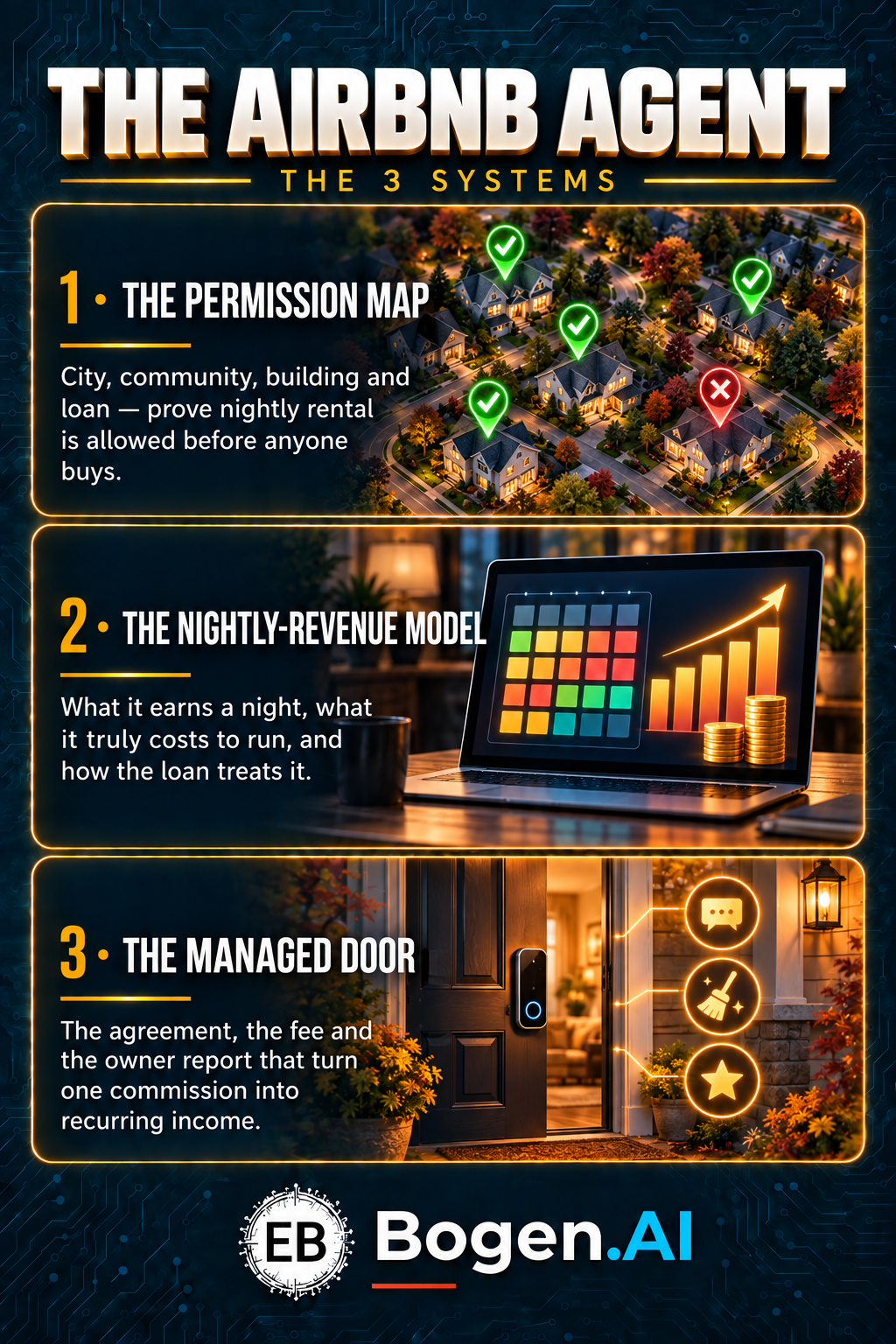
We will master 3 systems live, together:
1️⃣ The Permission Map — city, association, building and loan: prove nightly rental is allowed before anyone buys
2️⃣ The Nightly-Revenue Model — what it earns a night, what it truly costs to run, and how the loan treats it
3️⃣ The Managed Door — the agreement, the fee and the owner report that turn one commission into recurring income
Register for the SessionSell the property, then run it — the commission is one-time, the management fee renews every month it books
| Model | Published range | Source |
|---|---|---|
| Co-hosting (owner keeps the account; you run it) | 10–20% of revenue — and Airbnb's own page observes co-hosts "typically charge 15–25% for ongoing support" | Evolve's published explainer; Airbnb co-host page |
| Full service, local | 25–35% of revenue | Evolve's published explainer |
| National platforms | Evolve 10% or 15% plus a $250 onboarding fee, charged only after check-in; Awning from 10% | Company pricing pages |
| Boutique full service | One Smoky Mountain firm publishes 25% plus a $500 setup fee, 18 pricing periods a year, 24/7 call centre | Smoky Vistas pricing page |
Two things that are not true: there is no recognized "certified short-term rental manager" credential — what matters legally is your state licence — and no major national brokerage has a short-term rental division. The niche is open.
Four layers have to say yes, and any one of them can make a property unrentable after closing
| Layer | What can stop you | What to get in writing |
|---|---|---|
| 1 · City / county | Registration or permit requirements, caps and waitlists, primary-residence rules, zoning overlays, minimum stay, whether a permit transfers on sale. | The permit page, the ordinance section number, and an email from the licensing desk. |
| 2 · Association | Minimum lease terms, bans on transient use, leasing caps, board approval of guests, and the power to change the rules later. | The declaration, bylaws, rules and amendments — with the clause quoted. |
| 3 · Building / landlord | Whether the lease permits subletting at all. Airbnb's friendly-buildings program lists nearly 2,000 properties globally — a short list, not a market. | The lease clause or the building's written policy. |
| 4 · The loan | A second-home loan can be breached by the management agreement itself. Projected nightly income usually can't be used to qualify. | The lender's answer in writing, before the offer. |
I'm evaluating [ADDRESS or NEIGHBORHOOD, CITY, COUNTY, STATE] for short-term rental use. Build me a verification plan, not an answer. List: (1) every layer of rule that could apply — city ordinance, county, zoning overlay, state preemption, special district; (2) the exact search terms and the pages to look for on the municipal site (zoning code chapter, STR registration or permit page, licensing portal, tax collector); (3) the questions to ask the planning or licensing desk, in the order to ask them, including whether a permit exists, whether it is capped or waitlisted, whether it transfers on sale, whether primary residency is required, and what the enforcement history is; (4) what written proof to request. Do NOT tell me what the rule is. For anything you believe you know, write "VERIFY — [the specific question]".
I've uploaded the governing documents for [COMMUNITY/BUILDING]: [LIST — declaration/CC&Rs, bylaws, rules and regulations, any amendments, the lease if applicable]. Find every provision that could affect short-term rental: minimum lease term, transient or hotel use language, leasing caps or waitlists, owner-occupancy or ownership-duration requirements, board approval of tenants or guests, guest registration, amenity access for renters, fines and enforcement, and any amendment power to change leasing rules later. For each: quote the exact clause with its document and page, then say in one plain sentence what it means for a buyer who wants to rent nightly. If the documents do not address nightly rental, say NOT ADDRESSED — and list that as a written question for the association.
I work [MARKET]. Here is my list of candidate buildings, subdivisions or communities with what I have confirmed so far: [PASTE]. Organise them into ALLOWED / RESTRICTED / UNKNOWN based only on the evidence I pasted. For each, record the evidence (document name, date, who confirmed it) and the single question that would move it out of UNKNOWN. Then write the research order — which unknowns are worth resolving first based on price point and inventory. Invent nothing.
Turn the above into a one-page summary for my buyer client [NAME] on [ADDRESS]: what is permitted, what is restricted, what is still unverified, who we are waiting on, and the dates. Plain language, no legal conclusions, and end with: "This summarises the documents and public information we reviewed on [DATE]. Confirm current rules with the municipality and have the governing documents reviewed by your attorney before you rely on them."
| "Arizona passed a new short-term rental law this year." | HB 2429 was held in the Senate in March 2026 and did not become law. |
| "New York City relaxed its rules for small homes." | It did not — the 2024 bill died and a 2026 bill is still in committee. |
| "Dallas banned short-term rentals in neighbourhoods." | Those ordinances are enjoined and not in effect, with an appeal pending — confirm the current status before advising anyone. |
| "It's grandfathered, so my buyer is fine." | In Tennessee grandfathered status ends at the sale. Check how your state treats transfer before you market it that way. |
Where the rules are moving: New York City's registration law left about 3,522 registered hosts as of June 2026 against roughly 23,000 before it, and the Fifth Circuit upheld New Orleans' ordinance. Meanwhile Texas, Arizona, Idaho and Indiana preempt local bans — Indiana's cap ban passed 91–3 in 2026. AirDNA reports the fastest supply growth in small-city and rural markets, which is exactly where new ordinances are landing.
A nightly rental is a small hospitality business — price it like one, and never hand an investor a single number
| Number | What it is | Where investors get fooled |
|---|---|---|
| Average daily rate | What a booked night earns before fees. | Quoting peak-season rates as the annual average. |
| Occupancy | Share of available nights that book. | At the 2026 national average of 57.4%, roughly four nights in ten are empty. |
| Revenue per available night | Rate multiplied by occupancy — the only fair way to compare two properties. | A high rate with low occupancy loses to a modest rate that stays full. |
| Cost to operate | Cleaning, supplies, utilities, insurance, platform fees, management, taxes, reserves. | Spreadsheets that treat gross bookings as income. |
I'm analysing [ADDRESS, BEDS/BATHS, SLEEPS, KEY AMENITIES]. Here is the active and historical nightly-rental data I pulled from [SOURCE, DATE]: [PASTE]. Build a comparable set of 8-12 nightly rentals that truly match on bedrooms, sleeping capacity, amenity tier (pool, hot tub, parking, pet policy), walkability or drive time to the demand driver, and property type. For each comp show nightly rate, occupancy, and seasonality as given in my data. Exclude any comp that differs on a factor you name. Then summarise the range — low, middle, strong — and the single biggest difference between my subject property and the strongest comps. Use only my pasted data; if something is missing, say so.
Build the annual operating sheet for [ADDRESS] from my inputs: [PASTE what you know — cleaning fee and number of turnovers, supplies, utilities, internet, landscaping or snow, pool or hot tub service, pest, insurance quote, HOA dues, property tax, permit and registration fees, lodging tax handling, platform fees, software, maintenance reserve, management fee]. Show monthly and annual, separate fixed from per-stay costs, and flag every line I left blank as MISSING — do not estimate it. Add a one-time startup section: furnishing, linens, kitchen, smart lock, photography, permit application. End with cost per booked night at [X]% occupancy using only my numbers.
Using the comp set (2.1) and the cost sheet (2.2), produce three scenarios — conservative, expected, strong — each with nightly rate, occupancy, gross revenue, operating costs and net before debt service. For each scenario list the assumptions in one line each, and what would break it (a new permit cap, a competitor opening, a seasonal shift, a major repair). Label the output: "Estimates based on comparable listings and the costs provided. Not a guarantee of income; results vary with regulation, demand and operations." Never present a single number as the expected income.
My buyer is considering [second home / investment property / LLC purchase] at [ADDRESS] and intends to rent it nightly, with me managing it. Write the questions they must ask their lender BEFORE they sign anything, covering: whether the loan product permits nightly rental at all; whether a second-home loan's occupancy terms are breached by a management agreement that controls occupancy; whether projected short-term rental income can be used to qualify, and what documentation the lender would need; what a debt-service-coverage loan would require instead (credit, down payment, reserves, entity ownership, rate difference); and what happens to the loan if the city later bans the use. Format as a numbered list my client can email to the lender. Do not state what any lender's rule is — these are questions, and the answers must come in writing from the lender.
The financing trap most agents miss: Fannie Mae's second-home rules say the property "must not be rental property" and must not be "subject to any agreements that give a management firm control over the occupancy." Sell a buyer a second-home-financed property, then sign them into a management agreement that controls the calendar, and you may have helped put their loan in breach. Rental income from a second home can't be used to qualify at all — projected nightly income is a debt-service-coverage product feature, not a conventional one.
What Airbnb actually gives a manager, in Airbnb's own words — and the four things it does not
| What you get | What Airbnb's own pages say |
|---|---|
| A marketplace of owners | The Co-Host Network is live in thirteen markets, including the US and Canada. Owners search by location, read co-host profiles and ratings, and send requests. |
| A standard of entry | To join: an active listing, ten or more stays (or three totalling 100+ nights) in twelve months, a 4.8 rating, cancellations under 3%, verified ID, and a profile in your individual name — not a business. To stay: a 4.7 rating and a 90% response rate within 24 hours. |
| Native payouts | Four split structures — cleaning fee, cleaning plus a percentage, a percentage, or a fixed amount. Airbnb takes no cut of the co-host's payout, and co-hosts are paid before the owner. |
| An observed market rate | Airbnb's page notes co-hosts "typically charge 15–25% for ongoing support" — an observation, not a rule or a cap. |
I am a licensed real estate [agent/broker] in [STATE] and I want to manage short-term rentals for clients. Draft three things: (1) the exact questions to put to my broker in writing — does the brokerage permit this, must the agreement and the fee run through the brokerage, what supervision applies, what does the office policy say; (2) a one-sentence email to my errors-and-omissions carrier asking whether my current policy covers short-term rental management services, and what to ask for if it does not; (3) the questions for a local real estate attorney — whether this activity requires a licence in my state, whether any exemption applies, how guest and owner money must be held, and what my written agreement must contain. Do not answer these questions yourself; produce the asks.
Help me design my management fee for [MARKET]. My inputs: expected gross booking revenue per property [RANGE], my time per property per month [HOURS], my costs [software, assistant, drive time, supplies], and the fee models I'm weighing [percentage of payout, percentage of gross, flat monthly, per-turnover, hybrid]. For each model show my income per property per month, my effective hourly rate, and how income changes if occupancy drops by a quarter. Then show how many managed properties I need to replace [TARGET MONTHLY INCOME]. Note which costs I should pass through to the owner rather than absorb, and what I should charge separately (setup, furnishing, photography). Use only my numbers.
Draft an outline — not a contract — of the management/co-hosting agreement I will ask my attorney to prepare for [STATE]: parties and whether the brokerage is a party; scope of services and what is expressly excluded; term and termination with notice; the fee, when it is earned and how it is collected; whose platform account hosts the listing and who owns the listing, reviews and guest data; how guest payouts and owner funds flow and where they are held; who pays for supplies and repairs and the spending limit before owner approval; insurance each party carries; indemnity and limitation of liability; permits, registration and lodging-tax responsibility; guest screening and house rules; damage claims; and what happens if the property is sold. For each item add the one question my attorney needs me to answer. Label it: "Outline for attorney drafting — not a contract and not legal advice."
Write how I introduce management to a buyer client [NAME] who is purchasing [ADDRESS] as a nightly rental. It must: acknowledge that I represented them in the purchase and that management is a separate service with a separate agreement; state the fee plainly; say what they get and what they still own (decisions, costs, final say on price); and invite them to compare me with other managers. No pressure language, under 200 words, and include a line disclosing my dual role that my broker can approve.
Write this month's owner report for [ADDRESS] from my data: [PASTE nights booked, nights available, nightly rates, gross revenue, fees, expenses with receipts, maintenance issues, reviews and ratings, cancellations]. Structure: the month in three sentences; the numbers table; what I changed (pricing, photos, minimum stay) and the result; problems and how they were resolved; what I recommend for next month and what it would cost; and anything I need the owner to decide. Plain English, no jargon, under 400 words. Flag any number I did not provide as MISSING.
My management owner at [ADDRESS] is [selling / moving to another manager / converting to long-term]. Build the handoff: what transfers and how (listing ownership, reviews, future bookings and guest deposits, smart-lock codes, utility accounts, permits and registrations, tax accounts), the notice required under our agreement, the sequence and dates, what I keep, and the written confirmations to collect. If they are selling, add the questions that decide whether the buyer keeps the operation running — and the line where I offer to list it.
The line that sells your service: "The platform says the owner is responsible for verifying their manager's licence and insurance. I'm licensed, I work under a broker, and here is my coverage in writing." Most co-hosts competing with you cannot say that sentence.
The exemption that lets you do this work is the same exemption that removes your safety net
| State | Licensed activity? | Authority |
|---|---|---|
| Florida | No, if the property holds a state vacation-rental licence | Fla. Stat. § 475.011(11) |
| Arizona | No, for occupancies of 31 days or fewer | A.R.S. § 32-2121(A)(15) |
| California | No, for transient occupancies subject to transient occupancy tax | Bus. & Prof. Code § 10131.01(a)(2) |
| Colorado | No — the Commission has said short-term rental is not brokerage | CREC Commission Position 12 |
| North Carolina | Yes | N.C.G.S. § 93A-2(a); Vacation Rental Act |
| Texas | Assume yes — the hotel carve-out doesn't clearly reach a single-family rental | Occ. Code § 1101.002; TREC guidance |
| Everywhere else | Ask | Your state commission and a local attorney — in writing |
The trap: "no licence needed" also means "no safety net." Trust-account rules, the audit trail and your mandated errors-and-omissions policy are all written around licensed activity. Colorado's rule requires coverage for "all acts for which a licence is required" — and Colorado has formally said short-term rental hosting isn't one. Colorado is the one state verified to have closed that loop deliberately, by pulling short-term rental deposits back into trust accounting. Ask your carrier, in writing, whether your policy covers short-term rental management — and keep the answer.
Two reasons to get your broker's answer in writing first: Colorado's Commission requires property management services to be "performed and contracted in the name of the Brokerage Firm" with the employing broker's permission, and notes property management is one of its leading sources of complaints. And in Florida and California, a licensee who collects a fee for work requiring a licence they didn't properly hold can be left unable to enforce the contract — void in Florida, unenforceable in California. Your fee is only as good as the authority behind it.
Thirty days to a defensible niche and your first managed door
| Week | Actions |
|---|---|
| Week 1 — Permission | Run Prompt 1.1 on one market and call the licensing desk · Run Prompt 1.2 on one association's documents · Start the ALLOWED / RESTRICTED / UNKNOWN list |
| Week 2 — Permission to operate | Send the three asks from Prompt 3.1 — broker, E&O carrier, attorney · Get your brokerage's written position before you quote anyone · Price insurance and a software stack on no-cost tiers |
| Week 3 — The numbers | Run Prompts 2.1–2.3 on one real listing · Send the financing questions to two lenders, including one debt-service-coverage lender · Design your fee and decide your number of doors |
| Week 4 — The first door | Take the agreement outline to your attorney · Offer management to one past buyer who already owns a rental · Publish your permission map as a market piece — the best investor lead magnet you'll ever write |
The promise: one sale, two income lines — and never a property you sold that cannot legally be rented.
All 14 prompts, the worksheets, the licensing table and every source — in one PDF
The complete workbook includes the permission worksheet, the scenario and cost sheets, the financing comparison, the fee design worksheet, the Airbnb co-hosting rules in Airbnb's own words, the guardrails page and the 30-day plan.
Download the Workbook (PDF)Airbnb policy read on airbnb.com on October 2, 2026 — rules change, so verify before you rely on anything here
Educational resource: this is not legal, tax, insurance or investment advice, and nothing here is a projection or guarantee of rental income. Whether you may manage property for others, how you must hold client money, and what your agreement must contain are questions for your broker and a licensed attorney in your state. Confirm every local rule with the municipality and every loan question with the lender, in writing, before your client relies on it.