
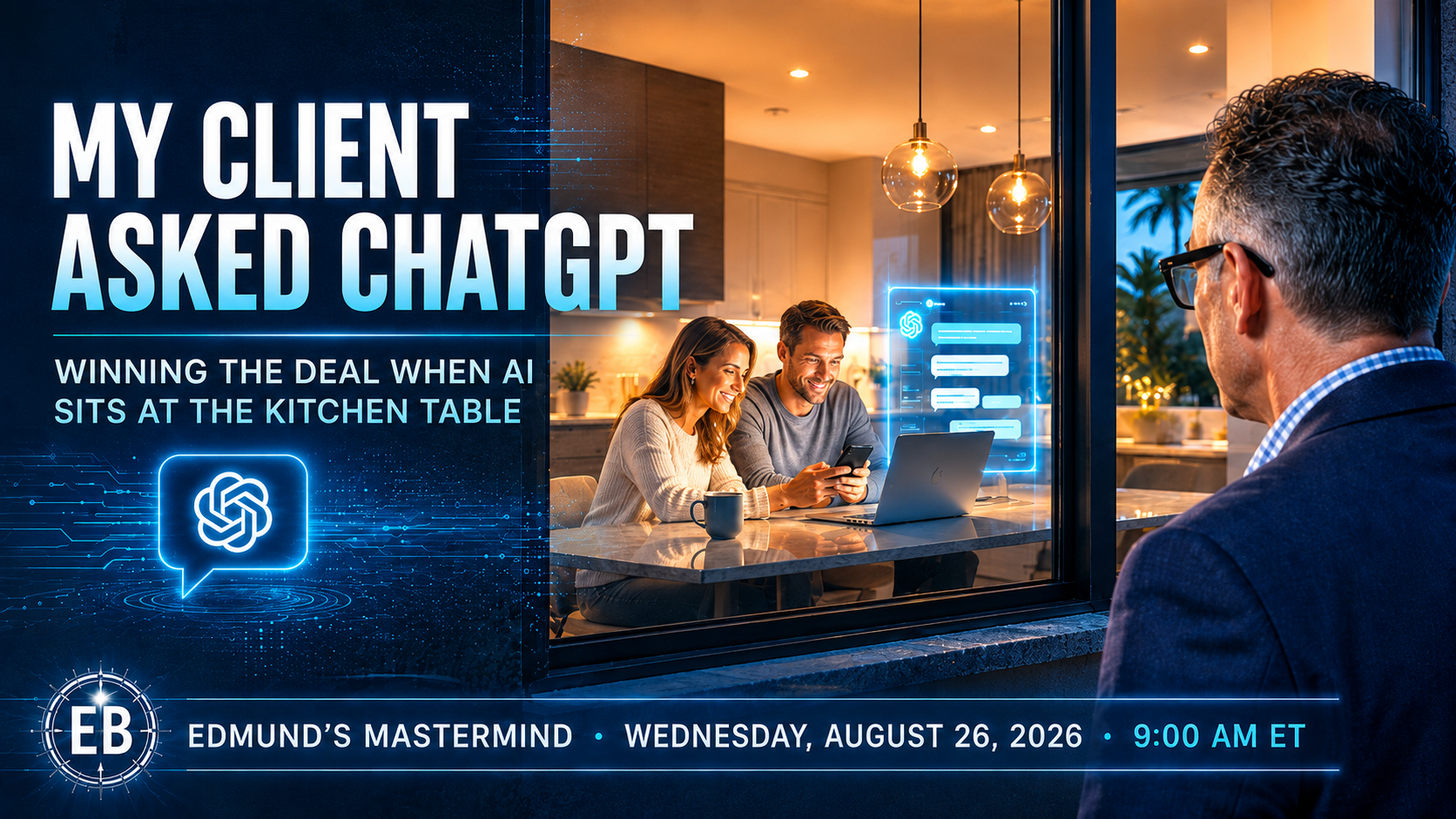
Winning the Deal When AI Sits at the Kitchen Table
82% of your clients now consult AI before or during their deal. The seller arrives with a hallucinated price. The buyer arrives with a chatbot's offer strategy. Most agents argue with it — and lose the room. This session builds the other move: know what AI told them before they say it, re-ask it together with a professional's prompt and real data, and let the corrected answer make your case for you. The bot becomes your demo assistant. The screenshot becomes your stage.
The full August 26 live session — the kitchen-table playbook, the Temporary Chat demo, and real agents' scripts
Four numbers that show why this hour is worth your while
Using AI in front of clients raises the stakes on accuracy, privacy, and fairness
The kitchen-table play works because it happens in the open — your screen, their question, real data. That same openness means the guardrails have to be airtight: the moment that showcases your professionalism can undermine it if a number goes unverified or a client's details end up in a public chatbot. Six rules, wired in from day one:
| Rule | What It Means at the Kitchen Table |
|---|---|
| Verify before you rely | Anything AI produces that a client might act on — numbers, rules, tax or legal claims — gets checked against MLS, your broker, or the professional source. In the live play, say the verification out loud: "let me confirm that against MLS." The checking IS the show. |
| Client data stays out of public AI | No names, no addresses tied to situations, no financials, nothing from a confidential relationship goes into a consumer AI chat. Anonymize everything: "a 3-bed waterfront in [AREA]." When in doubt, leave it out. |
| Fair housing applies to every script | Rebuttals, posts, and live prompts describe property, price, and lifestyle — never who "should" live somewhere. Add "keep all language fair-housing-compliant" to your standing prompts; scan every output anyway. |
| Stay in your lane | When the client's AI question crosses into legal, tax, lending, or appraisal territory, the advisor move is the referral — never let a chatbot's fluency tempt you into practicing someone else's profession. |
| Be straight about your AI use | Follow your brokerage's and state's disclosure rules. Good news: this session's method is AI use in the open, on your screen, as a demonstration. Transparency isn't a burden here — it's the technique. |
| Correct the data, respect the person | Never mock a client's AI research — live or in your content. "My client asked ChatGPT and it was WRONG lol" costs you every future client who also asked. Which is all of them. |
The professional's edge, stated plainly: AI is confident; you are accountable. License, fiduciary duty, MLS access, fair-housing training — the entire apparatus of accountability is what the chatbot lacks, and it's what these rules keep visible.
Know what the chatbot told them — before they say it
You can't answer an objection you've never heard. The Mirror Audit fixes that permanently: once a month, you ask the major AI tools the exact questions your clients ask them — about pricing in your zips, FSBO, commissions, timing, and which agent to hire — and write down what comes back. Twenty minutes later you hold something almost no agent in your market has: a current map of the misinformation (and the good information) your next ten appointments are walking in with.
The audit does three jobs at once: it ends the ambush — nothing a client quotes will surprise you, because you read it last Tuesday. It arms your scripts — System 3's rebuttals get rebuilt from what AI is saying this month, not last year. And it feeds your content — every wrong answer is a "What AI Got Wrong" post waiting to happen.
Run in a fresh chat — you want what your CLIENT sees
Run these logged-out or in a fresh session: your own AI accounts know you're an agent and answer differently.
I want you to answer exactly as you would for a regular consumer — not a real-estate professional. I'm a homeowner in [NEIGHBORHOOD, CITY] with a [BEDS]-bed [TYPE] I bought in [YEAR]. I'm thinking about selling. What's my home probably worth, is now a good time, and do I really need an agent? Answer the way you'd answer any homeowner asking.
Answer each of these as you would for a consumer in [CITY, STATE], one at a time, concisely: 1) What's a home worth in [NEIGHBORHOOD]? 2) Is now a good time to sell in [CITY]? 3) Can I sell without a realtor? 4) What commission should I pay? 5) Who are the best agents in [CITY]? 6) How much should I offer below asking? 7) What should I fix before selling? 8) Will prices drop in [AREA]? 9) How do I negotiate? 10) What are closing costs in [STATE]? Number your answers — I'm going to fact-check every one.
A homeowner in [CITY / NEIGHBORHOOD] asks: "Who should I hire to sell my house? Who are the top real-estate agents here, and how should I choose?" Answer as you would for them. Then, separately: what do you know about [YOUR NAME], the agent at [BROKERAGE]? What would make an AI assistant more likely to mention an agent by name in answers like this?
Here are AI's answers to my market audit [PASTE THE TEN ANSWERS]. And here is the real data from my MLS for the same period: [PASTE — closed sales, medians, DOM, absorption, actual commission/concession norms, actual closing-cost figures]. Compare them line by line. Build me a table: AI's claim | the reality | how far off | how a consumer would be misled. Rank the gaps from most expensive misunderstanding to least. These gaps are what my next ten clients believe walking in.
From my gap table [PASTE]: write my one-page "What AI Is Telling Your Neighbors This Month" brief for [AREA]. Format: three things AI gets roughly right about our market right now, three things it gets meaningfully wrong (with the real numbers), and one bottom line about why a local professional plus real data beats a general AI plus vibes. Warm, factual, zero AI-bashing — the tone of an advisor who checks so their clients don't have to. Keep it under 300 words.
Based on my gap table [PASTE] and what AI is currently telling consumers in [CITY]: predict the five AI-fueled objections I'm most likely to hear at appointments this month, phrased the way a client would actually say them ("ChatGPT said…"). For each: the emotion underneath it, the one data point that answers it, and the one sentence I should say first — before any data — to keep the client feeling smart rather than corrected.
Don't fight the chatbot — out-prompt it, in front of the client
When a client quotes AI at you, they're not attacking you — they're showing you their homework and asking you to grade it. Argue and you fail the moment: they feel foolish, you look threatened, and the bot's number stays lodged as "the thing my agent wouldn't engage with." The play does the opposite: you welcome the question, pull your chair around, and re-ask the AI together — this time with a professional's prompt and real data. The client watches the answer transform in real time. Nobody was wrong; the inputs just got better. And the person who knew how to get the better answer? That's their agent.
It's a live, side-by-side demonstration that the value was never the answer — it was knowing what to feed the question. The bot becomes your demo assistant. The hallucinated price becomes your CMA's warm-up act.
| Step | What You Say | What Happens |
|---|---|---|
| 1 · VALIDATE | "Smart — 82% of my clients check AI first now. Let's look at what it told you." | Pride preserved; you're allies, not adversaries |
| 2 · ASK TOGETHER | "Here's the same question, word for word. Now watch this…" | Their exact question, your screen, full transparency |
| 3 · UPGRADE | "Now let's tell it what a professional would tell it." | Role, constraints, honest-uncertainty ask — the answer visibly improves |
| 4 · LAYER TRUTH | "And now the real numbers — from data AI can't see." | Real comps pasted in; the gap between vibes and data appears on screen |
| 5 · ADVISOR CLOSE | "That's the difference between an answer and an assessment. My job is the inputs." | The lesson generalizes to everything you do — bridge to your CMA |
These run LIVE with the client watching — practice first
The calm is the product. Rehearse with Prompt 6 until the choreography is muscle memory.
Act as a senior residential appraiser in [CITY]. A homeowner wants to know what [ADDRESS-LEVEL DESCRIPTION — beds/baths/sf/condition/lot] is worth. Before answering: list what information you'd need for a defensible opinion, state what you do NOT have access to (current MLS, off-market activity, interior condition), and give your honest confidence level in any range you produce. Then give the range with those caveats attached.
Now here is the actual data for this property's market, from my MLS as of [DATE]: [PASTE — the 4–6 real comps with sold prices and dates, current actives, median DOM, absorption for the price band]. Revise your valuation using ONLY this data. Show: the revised range, which of the real comps drove it and why, how it differs from your first estimate, and what that difference means for a seller who priced off the first answer.
I'm going to show a homeowner the difference prompting makes. First, answer this as you would for anyone: "What's a [BEDS]-bed home in [NEIGHBORHOOD] worth?" Then answer the same question as a licensed local expert would ask it: with role, market context [PASTE ONE PARAGRAPH], and instructions to flag uncertainty. Present both answers side by side, then explain in two sentences — to the homeowner, not to me — why the answers differ and what that means about relying on the first kind.
Write my follow-up email to [CLIENT NAMES] after today's meeting where we explored their AI research together. Recap warmly: the question they'd asked AI, what we discovered together when we gave it better inputs and real data [PASTE THE KEY NUMBERS], and what we agreed the data actually supports. Frame them as smart for checking and smarter for verifying. Close with the agreed next step: [NEXT STEP]. Under 150 words, my voice: [PASTE A SAMPLE OF MY WRITING].
My buyers were told by AI to [WHAT IT SAID — e.g., "offer 12% under asking, waive nothing, cite national price drops"]. Here's this listing's reality: [PASTE — DOM, list-to-sale ratios for the area, competing-interest signals, seller situation as known]. As a buyer's-side strategist: assess AI's advice against this data, explain where generic strategy meets this specific market, and outline the offer approach the data supports — including what following the generic advice would likely cost them in this scenario.
Role-play with me. You are a smart, skeptical homeowner in [CITY] who has done extensive ChatGPT research before this listing appointment. You quote AI confidently: the price it gave you, the FSBO option, the 1% commission agents. Push back on everything I say using AI-sourced claims — realistically, not cartoonishly. I'll respond using my "Let's Ask It Together" technique. After each exchange, break character briefly: score my response on warmth, authority, and whether you (as the client) felt corrected or empowered. Then resume. Start now.
Scripts for the Big Five — and the content that answers before they ask
The kitchen-table play handles the live moment. The library handles everything around it: the objection on the phone before you've met, the 9 PM text with a screenshot, the follow-up where the cousin re-ran the question. Nearly every AI-fueled objection is a variation of five — the price, the FSBO, the commission, the timing, and "AI disagrees with your strategy" — and a script you've rehearsed beats an answer you improvise, every time, because composure is half the message.
The second half is positioning: instead of waiting to rebut, you publish. The monthly "What AI Got Wrong About [Your Market]" series — built directly from your Mirror Audit gaps — tells every future client you're not threatened by AI, you're fluent in it. The agent who checks the bot's homework doesn't have to argue with it at the table. Their reputation already did.
| The Objection | What's Really Being Said | The Script's Job |
|---|---|---|
| 1 · "ChatGPT says it's worth more" | "I want the higher number to be true — give me a reason to trust yours" | Honor the hope, show the inputs, let real comps set the anchor |
| 2 · "AI says we can FSBO" | "The commission feels big and the bot made selling sound easy" | Full-picture math: net proceeds, buyer pool, liability — no defensiveness |
| 3 · "AI says 1% agents exist" | "Prove there's a difference between agents" | The value stack with receipts — what your marketing measurably does |
| 4 · "AI says wait — prices will drop" | "I'm scared of mistiming this" | National headline vs. their street's data; the cost of waiting, quantified |
| 5 · "AI disagrees with your strategy" | "Reassure me you know something the free tool doesn't" | Welcome the check, name the local variable AI can't see, re-anchor the plan |
Scripts from THIS month's audit, in your voice
Feed these your Mirror Audit output — that's what makes them current instead of generic objection-handling.
Here is my objection forecast from this month's AI audit [PASTE] and a sample of how I actually talk [PASTE 2–3 PARAGRAPHS OF MY WRITING]. Write my five rebuttal scripts — one per objection. Structure each: the validating first sentence (never corrective), the one local data point that reframes it, the "let's look together" bridge, and the advisor close. Each script under 90 seconds spoken. My voice throughout — warm, direct, zero jargon, zero defensiveness.
A seller in [CITY] says AI told them FSBO could save them the commission. Build my response kit: 1) the validating open ("it's a fair question — let's run the real math"); 2) the full-picture worksheet comparing FSBO vs. represented sale on THEIR numbers — realistic sale-price differential [USE MY MARKET'S DATA: paste], marketing reach, negotiation outcomes, legal/disclosure exposure, days on market, and their hours at their hourly value; 3) the three questions they should ask ANY option, including me. End with the net-proceeds line, not the commission line — that's the number that decides.
A client says AI told them agents now negotiate to [X]% and asks why I charge what I charge. Using my actual deliverables [PASTE — your marketing system, launch process, negotiation record, whatever you truly do]: build my value-stack response. Structure: agree that everything is negotiable and service levels differ wildly; then the receipts — what my process measurably produces vs. a minimal service; then the reframe question ("which service level do you want representing your largest asset?"). No defensiveness, no bashing discount models — let the deliverables do the arguing. Under 2 minutes spoken.
From this month's gap table [PASTE]: write my 4-post "I Asked AI About [MY MARKET] — Here's What It Got Wrong (and Right)" series. Post 1: the price-estimate gap, with the real numbers. Post 2: the FSBO/commission claim vs. our market's reality. Post 3: the timing headline vs. our actual absorption data. Post 4: what AI got RIGHT — and why I check anyway (credibility through fairness). Each: a hook line, under 120 words, ends with "I run this check monthly — want next month's? DM me AUDIT." My voice [PASTE SAMPLE]. Fair-housing-safe, no fear-mongering, no AI-bashing.
Create the content for one listing-presentation slide titled "You've Probably Already Asked AI About This." Contents: what AI likely told them about their home's value and selling today [FROM MY AUDIT — paste the current answers], which parts are useful, which parts miss (with one real example from my market), and my one-line promise: "I don't compete with your chatbot — I bring the data it doesn't have." Layout notes for a clean navy/white slide. Tone: confident, amused, completely unthreatened.
Build my weekly practice circuit. You are three different AI-armed clients in [CITY], in sequence: 1) a warm past client who "just wants to check" the FSBO idea AI suggested; 2) a skeptical high-end seller with a screenshot claiming their home is worth 15% more; 3) a nervous buyer whose chatbot told them to wait for a crash. Run each as a 3-exchange role-play against my scripts [PASTE THE BIG FIVE]. After each character: score me 1–10 on validation, data use, and advisor close — and give the one line I should steal for next time. Total: 15 minutes.
From "ambushed by screenshots" to the most AI-literate advisor in your market
This skill protects every revenue line at its most fragile moment
Signed today. Audit this week; scripts next week; the play goes live within thirty days.
I don't argue with the chatbot.
I out-prompt it — in front of my client.
There's a new voice at the kitchen table, and it isn't going away. It answered my client's questions at eleven o'clock last night — fluently, confidently, and sometimes wrongly — and it will answer more of them tomorrow. I could resent that. Most agents will, quietly, and their clients will feel it.
I choose the other road. I read what the bot tells my market before my clients quote it to me. I welcome the screenshot instead of flinching at it. I pull my chair around to their side of the table, re-ask their exact question, and show them — live, kindly, in sixty seconds — what happens when a professional drives the same machine: better inputs, real data, honest uncertainty, and a number that can stand up at the closing table.
My value was never that I knew things a computer couldn't say. My value is that I know which things are true — because I check, because I'm licensed and local, because I was in three of those houses the week they sold. The chatbot is confident. I am accountable. That's the entire difference — and now I can demonstrate it on demand.
Validated. Asked together. Upgraded. Grounded. Closed.
Every screenshot is a stage now.
"Because Losing to a Chatbot is NOT an Option!"
— Edmund Bogen · Edmund's Mastermind · Bogen.ai