


The document pull, the red-yellow-green scorecard, and the listing-side confidence packet — prepared by Edmund Bogen
The risk in a condo deal usually isn't hidden — it's sitting in documents nobody opened: a reserve study, an inspection report, a special assessment discussed in last spring's board minutes. This session builds the workflow that gets those documents in hand early, uses AI to turn them into one page of questions with every flag quoted back to its source page, and routes real issues to the attorney, engineer, insurance agent, or lender who owns them. Florida's post-Surfside laws are the case study — and the lending rules that now apply in every state make it a national conversation.
The full October 7 live session — the Document Pull, the Red-Yellow-Green Scorecard and the Confidence Packet, run live on a real, redacted condo document set
Florida rewrote its condo rules after the 2021 Surfside collapse — but the pressure is national. About 78 million Americans live in community associations. Fannie Mae now treats critical repairs and significant deferred maintenance as a reason a condo project is ineligible for financing in every state, and Freddie Mac's reserve minimum rises from 10% to 15% of budgeted assessment income for loan applications dated on or after January 4, 2027.
You don't need to become a lawyer or an engineer. You need a system that surfaces the questions in time — and knows exactly who answers them.
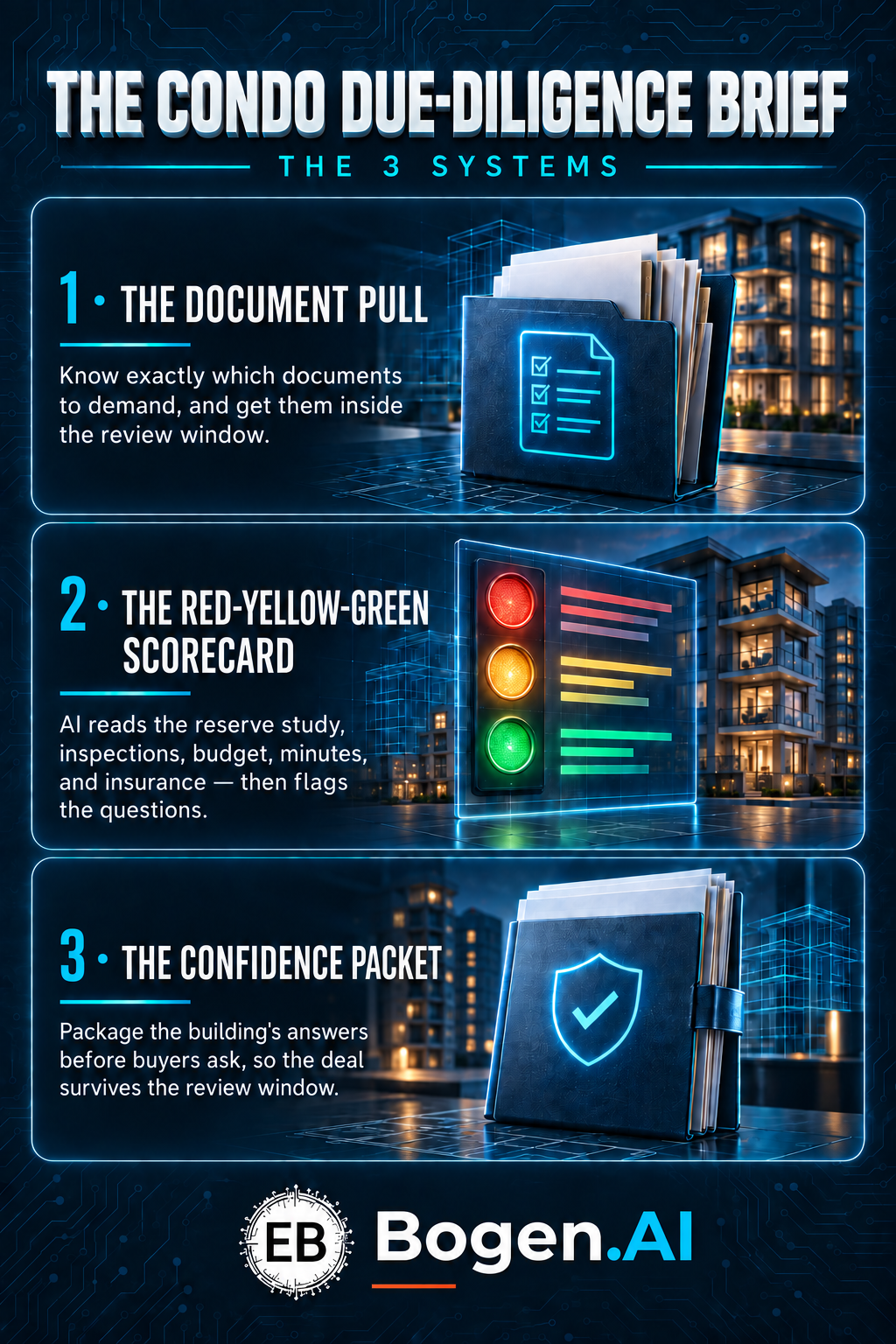
We will master 3 systems live, together:
1️⃣ The Document Pull — the checklist of what to demand, the request email, and a day-by-day tracker for your state's review window
2️⃣ The Red-Yellow-Green Scorecard — AI reads the reserve study, inspections, budget, minutes, and insurance, and quotes back every flag with its page
3️⃣ The Confidence Packet — the listing-side package that answers the building's questions before buyers ask
Watch the RecordingThe names vary by state. The questions don't.
| Document | The Question It Answers | What to Look For |
|---|---|---|
| Reserve study | Is the association saving enough for the big-ticket components it will have to replace? | Date, who prepared it, the funding plan, and the gap between recommended and actual contributions. |
| Inspection / engineering reports | Has a licensed professional found conditions that require repair? | Findings, required repairs, deadlines, and whether repairs have started. |
| Budget & financial statement | What does it cost to run the building, and is that changing? | Year-over-year changes, reserve line items, loans or lines of credit. |
| Board & owner meeting minutes | What's being discussed that hasn't hit the budget yet? | Special assessments, repair bids, insurance renewals, litigation, water intrusion complaints. |
| Insurance declarations | What is the master policy covering, and what's left to the owner? | Coverage types, deductibles, renewal date, flood coverage. |
| Declaration, bylaws & rules | Can the buyer use the unit the way they intend? | Rental restrictions, pet rules, approval requirements, assessment powers. |
| Lender questionnaire | Will the buyer's lender finance a unit in this project? | Pending litigation, delinquencies, critical repairs, special assessments. |
Minutes before marketing: the documents a seller must hand over tell you what was decided. The minutes tell you what's coming. Always request 12 months of board and owner meeting minutes.
Get the right documents, in writing, early enough that the review window works for your buyer
I'm representing a [BUYER/SELLER] on a resale condominium unit in [CITY, STATE]. Build me a document request checklist in three columns: (1) documents the seller or association is required to provide to a buyer under [STATE]'s condo resale disclosure rules — list only what you can cite to the statute, and write "verify with a local real estate attorney" for anything you are not certain applies; (2) documents a buyer's lender typically requests for a condo loan (project questionnaire, budget, reserve study, master insurance); (3) documents worth requesting even if not required (12 months of board and owner meeting minutes, current insurance declaration pages, engineering or inspection reports, pending special assessments, litigation). For each item add who usually holds it and the question it answers for the buyer. Do not state any deadline or day count unless you cite the statute section; otherwise write "confirm the review period in your contract and state law."
Write a short, professional email from me, [AGENT NAME], to the [LISTING AGENT / ASSOCIATION MANAGER] for [BUILDING NAME], unit [UNIT]. Request these documents: [PASTE CHECKLIST ITEMS]. Explain that the buyer's review period is time-sensitive and ask for delivery as PDFs with the date each document was issued. Ask them to confirm in writing if any listed document does not exist (for example, "no reserve study has been completed"). Friendly, precise, no pressure language, under 150 words.
Here is my executed contract date: [DATE], the date the buyer received the condo documents: [DATE], and the review period written in the contract/rider: [PASTE THE EXACT CLAUSE]. Build a day-by-day calendar from receipt to the end of the review period, counting days exactly the way the clause describes (if it excludes weekends and legal holidays, skip them and list which holidays you skipped). Mark: document review day, questions-to-association day, attorney/engineer consult day, and the last day to give written notice. If the clause is ambiguous, say so and tell me to confirm with the buyer's attorney — do not guess.
Florida example: for resale units the statutory window is 7 days, excluding Saturdays, Sundays, and legal holidays, after the later of contract execution and receipt of the required documents (s. 718.503(2), Fla. Stat.). Developer sales use a different, 15-day rule. Paste the clause — never type the number from memory.
One page your buyer can read in two minutes — every flag points back to its source page
| Color | Use It When the Documents Show… | Your Next Move |
|---|---|---|
| RED | A required repair, an approved or proposed special assessment, a lawsuit, or a required report that's missing. | Route to the attorney, engineer, or lender — before the window closes. |
| YELLOW | Something unclear, outdated, or discussed without a decision. | Send a written question to the association. |
| GREEN | Clearly addressed in current documents. | Note the source page; move on. |
No quote, no flag. Every row must cite the document and page. If the documents don't address it, the row says NOT FOUND — which is itself a question for the association. AI never decides whether reserves are "adequate" or whether the building is "safe."
You are helping a real estate agent summarize condominium association documents for a buyer. You are NOT giving legal, financial, or engineering advice. I've uploaded: [LIST — reserve study, inspection summary, budget, balance sheet, 12 months of minutes, insurance declarations, rules]. Produce a RED / YELLOW / GREEN scorecard with one row per topic: Reserve study (date, who prepared it, funding plan); Reserve balance vs. the study's recommended funding; Inspection findings and required repairs; Special assessments (approved, proposed, or discussed); Budget changes year over year; Insurance (coverage types listed, deductibles, renewal date); Litigation or claims mentioned; Delinquency / owner arrears mentioned; Rental or other use restrictions. For each row: color, a one-sentence plain-English summary, the exact quote and document/page it comes from, and "NOT FOUND" if the documents don't address it. RED = a required repair, approved/proposed special assessment, lawsuit, or missing required report; YELLOW = needs a follow-up question; GREEN = addressed clearly. End with: "This summary is not an opinion on the building's condition or the adequacy of reserves. Review with a community association attorney and, where repairs are noted, a licensed engineer."
From the scorecard above, write the questions the buyer should ask the association or management company — one question per RED or YELLOW row, each tied to the document and quote that prompted it. Group them: Money (reserves, assessments, budget), Building (repairs, inspections, timeline), Risk (insurance, litigation, delinquencies). Plain language, no accusations, maximum 15 questions.
I've uploaded 12 months of board and owner meeting minutes for [BUILDING]. List every mention of: special assessments, loans or lines of credit, reserve funding, engineering or inspection reports, repair projects and bids, insurance renewals or premium changes, litigation, and owner complaints about water intrusion or structural issues. For each: meeting date, a direct quote, and whether a vote was taken. Do not interpret or predict outcomes — list only what the minutes say.
Based on the scorecard, list which items the buyer should take to (a) a community association attorney, (b) a licensed engineer or architect, (c) an insurance agent, (d) the lender. One line each, explaining why, citing the document. Do not give your own opinion on the outcome.
Prep the upload: keep each report as its own PDF with original page numbers, name files with the document date, redact personal information first, and open the cited page for every RED and YELLOW row before anything goes to the buyer.
For listing agents: answer the building's questions before a buyer's review window starts the clock
I'm listing a condo unit at [BUILDING, CITY, STATE]. Using the documents I've gathered [LIST], build a "Building Confidence Packet" table of contents for buyers and their agents: each document, its date, what question it answers, and where it's posted (association website, management portal, or attached). Flag any document that is missing or older than [X] years so I can request an update before listing.
Write a one-page, factual building summary for the listing packet using ONLY the uploaded documents: building age and inspection history, most recent reserve study date and who prepared it, current reserve balance as stated, any approved special assessments and how they're payable, insurance coverage types and renewal date, and recent completed or scheduled projects. Cite the document for each fact. No marketing adjectives, no predictions, no statements about who the building is "perfect for." If something isn't in the documents, leave it out.
Before we list, compare the documents we have [LIST] against what a buyer and a buyer's lender will ask for. Tell me what's missing, what's outdated, and which items are likely to trigger questions during the buyer's review period — citing the document for each. Then draft a short, friendly request from my seller to the association manager for the missing items.
Write a short note to buyers' agents that accompanies the packet: what's included, the dates of the key reports, and an invitation to send questions early in the review period. Factual, professional, under 120 words. No claims about the building's condition beyond what the documents state.
| Lender Will Ask About | Put This in the Packet |
|---|---|
| Critical repairs & deferred maintenance | Most recent inspection or engineering report, and the status of any required repairs |
| Reserves | Current budget showing the reserve line, and the most recent reserve study |
| Special assessments | Purpose, approval status, amount, and payoff date for each |
| Insurance | Master policy declaration pages, including deductibles |
SB 4-D (2022), SB 154 (2023), HB 1021 (2024), and HB 913 (2025, effective July 1, 2025)
| Rule | What It Requires |
|---|---|
| Milestone inspections s. 553.899 | Condo and co-op buildings three habitable stories or more: by December 31 of the year the building reaches 30 years from its certificate of occupancy, then every 10 years (a local agency may require 25 years based on local conditions, including proximity to salt water). Phase one visual exam; phase two testing only if substantial structural deterioration is found. The association distributes the inspector's summary to every owner within 45 days; local ordinances must require repairs to begin within 365 days after a phase two report. |
| Structural Integrity Reserve Study s. 718.112(2)(g) | Residential condo buildings three habitable stories or higher, at least every 10 years, covering roof; structure and load-bearing walls; fireproofing and fire protection; plumbing; electrical; waterproofing and exterior painting; windows and exterior doors; and other items over $25,000 (inflation-adjusted). Deadline December 31, 2025 for associations existing on or before July 1, 2022 — or no later than December 31, 2026 when done alongside a milestone inspection. |
| Reserve funding s. 718.112(2)(f) | For budgets adopted on or after December 31, 2024, owners may not waive or reduce reserves for SIRS components. Funding may come from regular assessments, special assessments, lines of credit, or loans (the last three require a majority of the total voting interests). |
| Resale buyer rights s. 718.503(2) | The seller provides: governing documents, financial statement and budget, the milestone inspection summary, the most recent SIRS (or a statement none has been completed), the turnover inspection report where applicable, the FAQ document — plus the DBPR governance form. 7 days to cancel, excluding weekends and legal holidays (raised from 3 days by HB 913, effective July 1, 2025). |
| Condominium Rider | Current Florida Realtors/Florida Bar form is CR-7 (Rev. 06/2025). It allocates special assessments, requires disclosure of assessments levied or discussed at board meetings in the prior 12 months, and lets the buyer request 12 months of minutes and insurance declaration pages. Always pull the live form. |
| Association websites s. 718.111(12)(g) | Associations with 25 or more units must post official records online — including milestone and SIRS reports — since January 1, 2026 (down from 150 units). |
| Market | Sales (YoY) | Median Price (YoY) | Months of Supply |
|---|---|---|---|
| Florida condo-townhouse | 8,194 (+11%) | $295,000 (flat) | 7.8 |
| Miami-Dade existing condo | 1,026 (+11.4%) | $400,000 (−1.48%) | 12 |
| Broward | 1,018 (−2.77%) | $255,000 (−3.77%) | 10 |
| Palm Beach | 914 (+18.55%) | $312,500 (+3.99%) | 6.7 |
Sources: Florida Realtors and Miami Realtors market reports (August 17, 2026). Legal facts: Fla. Stat. ss. 553.899, 718.111, 718.112, 718.503 (2026); HB 913 (2025) enrolled text; Florida DBPR.
Enacted rules verified in statute or agency text — if your state isn't listed, confirm locally
| State | What the Law Requires of the Building | What the Buyer Gets at Resale |
|---|---|---|
| California | SB 326 (Civil Code §5551): condo buildings with 3+ units and wood-based balconies, decks, stairways, or walkways more than 6 feet up — first inspection by January 1, 2025, then every 9 years, by a licensed engineer or architect. Reserve study visual inspection at least every 3 years (§5550). | Since January 1, 2026, the resale packet includes the most recent balcony inspection report (§4525). |
| New Jersey | Residential Structural Integrity Law (P.L.2023, c.214, signed January 8, 2024): structural inspections by a licensed NJ engineer for condo and co-op buildings with concrete, masonry, steel, or hybrid load-bearing structures. | Ask for the structural inspection and reserve study; confirm current timelines with a New Jersey attorney. |
| Maryland | HB 107 (2022): reserve studies for condos and co-ops, updated every 5 years, with budgets funding the recommended level. | Reserve study or summary in the resale packet; 7 days to cancel after receiving all required information (§11-135). |
| Virginia | Condo reserve study at least every 5 years, reviewed annually (§55.1-1965). | Resale certificate includes the reserve study or a summary; 3 days to cancel after receiving it (§55.1-2312). |
| Washington | Reserve study updated annually, with a professional study and site visit at least every third year (RCW 64.90.545). | 5 business days to cancel after first receiving the resale certificate when delivered 5 or fewer business days before signing (RCW 64.90.640). |
| Nevada | Reserve study at least every 5 years by a state-permitted specialist (NRS 116.31152). | Until midnight of the 5th calendar day after receiving the resale package (NRS 116.4109). |
| Texas | — | Condo buyer who didn't receive the resale certificate before signing may cancel before the 6th day after receiving it (Prop. Code §82.156). |
| Arizona | — | Resale disclosure includes the most recent reserve study, if any; no statutory cancellation right (§33-1260). |
| New York City | Façade Inspection & Safety Program (Local Law 11): buildings taller than 6 stories, including condos and co-ops, inspected every 5 years. | Ask for the most recent façade filing and any required repairs. |
Colorado's mandatory reserve-study bill (HB22-1387) was vetoed. Every one of these laws creates a report a buyer can ask for — add your state's version to the document pull, and paste your state's actual review-period clause into Prompt 1.3.
State laws decide what reports exist. Fannie Mae and Freddie Mac decide whether a buyer can get a conventional loan.
| Rule | What It Says |
|---|---|
| Today (Fannie Mae B4-2.2-01) | The budget must allocate at least 10% to replacement reserves; baseline funding may not be used to waive it; a reserve study used instead must be no more than 3 years old. |
| Since August 3, 2026 (Freddie Mac Bulletin 2026-C) | Streamlined review retired — more projects get a full review. |
| January 4, 2027 (Freddie Mac Bulletin 2026-C) | Reserve minimum rises from 10% to 15% of budgeted assessment income for applications dated on or after this date. Fannie Mae made parallel changes (Lender Letter LL-2026-03), now incorporated into its Selling Guide. |
| Condo & co-op existing-home sales, August 2026 | 360,000 annual rate (−2.7% year over year); median $371,600 (+1.5%) — NAR, September 10, 2026 |
| Community associations in the U.S. (2025) | 373,000 associations · 29.6 million housing units · 78.1 million residents — CAI Foundation |
| Why lenders said no (CAI Foundation survey, May 2026 — 247 respondents in 36 states) | 23% reserve funding · 21% a structural maintenance project · 20% insurance requirements |
A loan on a unit in an ineligible project can't be sold to Fannie Mae or Freddie Mac. FHA and VA have their own project approval rules — ask the buyer's lender early.
The system works because it knows where the agent's job ends
| Question | Who Answers It |
|---|---|
| Is the contract enforceable? What does this clause mean? | A community association or real estate attorney. The Realtor Code of Ethics (Article 13) prohibits the unauthorized practice of law and calls for recommending legal counsel. |
| Is the building structurally sound? Are these repairs serious? | The licensed engineer or architect who signs the inspection report. |
| Are the reserves "adequate"? | Not the agent and not the AI — the reserve study preparer, the association, and the buyer's advisors. |
| Will the loan get approved? | The lender. |
| What does the policy cover? | A licensed insurance agent. |
Fair housing: keep every AI output about the building, the finances, and the documents — never about who lives there or who the unit is "right for."
Install the system on one live file, then make it the default for every condo you touch
| Week | Actions |
|---|---|
| Week 1 — Know the rules | Confirm your state's condo resale disclosure rule and review period with your broker or attorney · Pull your current condo rider or addendum · Save Prompts 1.1–1.3 in your prompt library |
| Week 2 — First scorecard | Request a full document set on one active or past condo file · Run Prompts 2.1–2.3 and check every quote against the source page · Line up a community association attorney and engineer you can refer |
| Week 3 — Listing side | Build a Confidence Packet for one condo listing (Prompts 3.1–3.3) · Send the buyer-agent heads-up with the packet (Prompt 3.4) |
| Week 4 — Make it default | Add the document pull to your condo contract-to-close checklist · Share one anonymized scorecard example with your sphere · Review what the minutes revealed that the required documents didn't |
The promise: no condo buyer of mine discovers a special assessment after the review window closes.
Every prompt, checklist, worksheet, and source — in one PDF
The complete workbook includes the document pull worksheet, the scorecard format, the confidence packet checklist, the Florida deep dive, the state-by-state and lending pages, the guardrails card, and the 30-day plan.
Download the Workbook (PDF)Verified September 15, 2026 — laws and forms change, so confirm before relying on any date or deadline
Educational resource: this workbook is not legal, engineering, insurance, or lending advice. AI-generated summaries must be checked against the source documents, and conclusions belong to licensed professionals in each field. Always follow your broker's policies and your state's rules.