
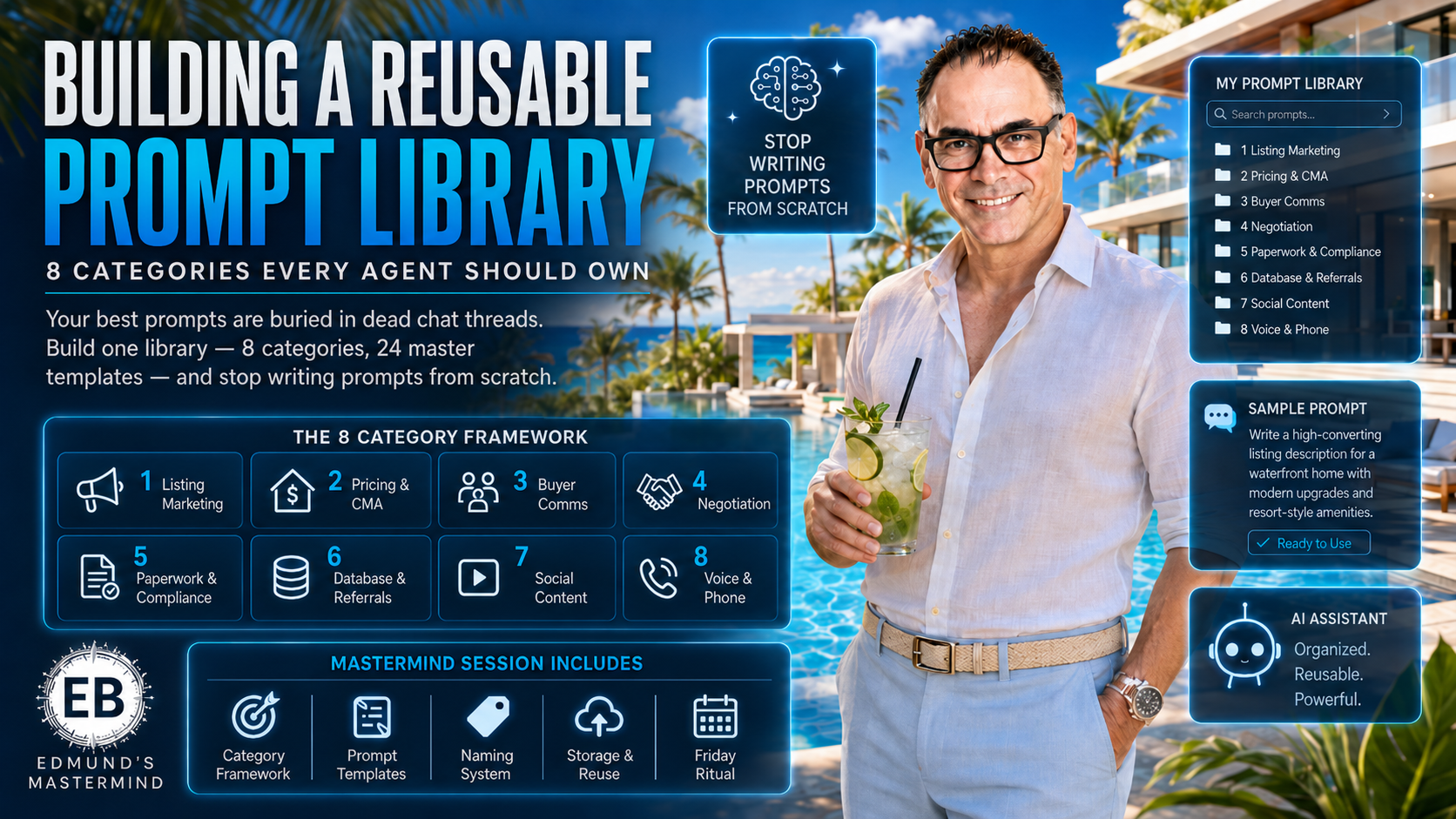
8 Categories Every Agent Should Own — Stop Retyping, Start Compounding
Your best prompts are scattered across a hundred dead chat threads. Tonight that ends: one library, 8 categories, 24 master templates — 15 seconds from "I need this" to a paste that works every time.
The numbers that make today's session non-negotiable
The master-prompt formula and the one home your templates live in
A prompt that worked once is an asset. A prompt you have to find is a liability. The difference between agents drowning in chat history and agents running a machine is that the machine crowd made one decision: prompts are business documents — written once, stored in one place, improved on a schedule.
Every master template follows the same five-part anatomy: PERSONA (who the AI is), GOAL (the exact deliverable), ANTI-GOAL (what it must never do — clichés, fair-housing risk, "nestled"), [VARIABLES] (the bracketed slots you fill per use), and OUTPUT SPEC (format, length, versions). Five parts, every time — that's what makes a prompt reusable instead of lucky.
The AI builds your library structure — copy, paste, fill in [ ]
Run these live during the session. Prompt 2 is the engine of the whole night — it converts prompts that already worked into permanent templates.
Build my prompt library structure for [NOTION / GOOGLE DOC]. Eight categories: Listing Marketing, Pricing & CMA, Buyer Comms, Negotiation, Paperwork & Compliance, Database & Referrals, Social Content, Voice & Phone. For each: a one-line description of what belongs there, the naming convention [PREFIX]-[name]-v[#], and an empty template card with the five sections (Persona / Goal / Anti-Goal / Variables / Output Spec) ready to duplicate. Output as a structure I can paste directly.
Here's a prompt that produced a great result for me: [PASTE THE ONE-OFF PROMPT]. Convert it into a master template: 1) extract the reusable PERSONA, 2) state the GOAL precisely, 3) infer the ANTI-GOALS from what good output avoided, 4) replace every specific detail with [BRACKETED VARIABLES] and list them, 5) add an OUTPUT SPEC (format, length, versions). Then show me the finished template card plus one example of it filled in.
Write my persona bank: one reusable AI persona per library category (8 total). Each persona is 2–3 sentences: expertise, point of view, and how it writes — calibrated to my voice profile [PASTE OR REFERENCE] and my market [CITY/NICHE]. Example shape: "You are a luxury listing copywriter with 20 years in [MARKET] who writes vivid, specific, fair-housing-safe copy and never uses clichés." Make each distinct enough that swapping personas visibly changes the output.
Here are 3 AI outputs I rejected or heavily edited: [PASTE THEM]. Diagnose exactly what made them fail — clichés, generic claims, wrong tone, invented facts, fair-housing risks. Turn the diagnosis into a reusable ANTI-GOAL block I can paste into every template: "Never: [the list]." Then rewrite one of the rejected outputs with the anti-goals applied so I can see the difference.
Eight categories × three master templates — the working library
You don't need 200 prompts. You need 24 that you trust — three per category, covering create / analyze / communicate. Every category follows the same pattern: one template that makes something (a listing launch, a social batch), one that reads something (comps, a contract, your database), and one that says something (the follow-up, the ask, the hard conversation).
And you don't write them from scratch. Tonight's move is conversion: mine your chat history for the prompts that already produced wins, run each through the Template Converter, and file it. An hour of conversion beats a month of invention.
Four of the Core 24, ready to customize — the full grid of 24 is in the workbook
Each of these IS a master template — persona, goal, anti-goal, variables, output spec. Run them tonight, then convert your own.
PERSONA: You are a luxury listing copywriter in [MARKET] who writes vivid, specific, fair-housing-safe copy. GOAL: A complete launch for [ADDRESS] — features [DETAILS], likely buyer [PROFILE]. ANTI-GOAL: Never use "nestled," "boasts," "stunning," or any reference to who should live there — property and location only. VARIABLES: address, details, profile, open-house date. OUTPUT: 1) MLS max 250 words, 2) Instagram caption with hook, 3) 60-sec video script — each clearly labeled.
PERSONA: You are a pricing strategist who turns comp data into stories sellers accept. GOAL: The living-room pricing narrative for [ADDRESS]; seller believes [THEIR NUMBER]; my comps [PASTE]; my range [RANGE]. ANTI-GOAL: Never invent data, never bash the seller's number, never promise a sale price. VARIABLES: address, seller's number, comps, range. OUTPUT: the narrative (under 400 words), 3 questions to ask before revealing my number, and the "but Zillow says" response.
PERSONA: You are a real estate negotiation strategist who prioritizes my client's actual interests over "winning." GOAL: I represent the [SIDE] at [ADDRESS]; offer on the table [TERMS]; other side's position [KNOWN]; client's priorities [PRICE/TIMING/CERTAINTY]. ANTI-GOAL: No bluffs I can't back, nothing that risks the relationship with the co-op agent, no legal advice. VARIABLES: side, address, terms, known, priorities. OUTPUT: 3 counters ranked by acceptance odds with exact language, plus the pre-agreed walk-away line.
PERSONA: You are a database strategist who believes every quiet contact is a future closing. GOAL: Segment these 6+ month dormant contacts [PASTE: name / last interaction / source / notes] into likely-seller, likely-buyer, referral source, archive. ANTI-GOAL: No guilt-trip openers, no "just checking in," nothing that sounds mail-merged. VARIABLES: the export, my value offer [FORM/MARKET UPDATE]. OUTPUT: the four segments as lists, plus one re-engagement message per active segment in my voice.
Test, grade, version, retire — the 10-minute ritual that keeps the library alive
Libraries die the same way CRMs die: built in a burst of enthusiasm, never touched again. The fix isn't discipline — it's a tiny ritual with a trigger. Every Friday, 10 minutes: which template did I use most? Which output did I edit hardest? That edit becomes a version bump. Which template did I not touch in a month? It gets retired or merged.
This is where the compounding happens. A template used 40 times and refined 6 times is an asset no competitor can copy — it encodes your market, your voice, and every lesson from every use. Your chat history disappears; your library appreciates.
The AI maintains the library too — grading, refining, and auditing on your behalf
These are the librarian's tools. Prompt 3 is the compounding engine — run it every time an output needed heavy edits.
Run both of these templates on the same real input and produce both outputs side by side: TEMPLATE A: [PASTE v1]. TEMPLATE B: [PASTE v2]. INPUT: [REAL CASE]. Then compare them on: specificity, my-voice match, anti-goal compliance, and readiness to ship without edits. Declare a winner and tell me exactly which lines made the difference.
Grade this output against its template's spec. TEMPLATE: [PASTE]. OUTPUT: [PASTE]. Score 1–10 on: goal delivered, anti-goals respected, voice match, factual discipline (nothing invented), output spec followed. For anything under 8, quote the offending line and say whether the fix belongs in the OUTPUT (one-off) or the TEMPLATE (systemic).
I used this template: [PASTE]. It produced: [PASTE OUTPUT]. Here's what I actually sent after editing: [PASTE FINAL]. Diff my edits, infer the rule behind each one, and produce the next version of the template with those rules baked in — so next time the first draft IS the final. Show the changelog: v[N] → v[N+1], what changed, why.
Run my 10-minute Friday library review. This week I used: [LIST TEMPLATES + ROUGH COUNTS]. Heavy edits happened on: [WHICH]. Untouched for 30+ days: [WHICH]. Tell me: 1) which single template earns a version bump this week and what the bump should be, 2) what to retire or merge, 3) one gap — a task I did manually this week that deserves a new template, 4) my library health score out of 10. Keep the whole review under 200 words.
Eight categories, three templates each: create / analyze / communicate
| Category | Create | Analyze | Communicate |
|---|---|---|---|
| 🏠 Listing Marketing | Listing Launch | Listing Audit (vs. comps' copy) | Open-House Promo |
| 💲 Pricing & CMA | CMA Narrative | AVM Rebuttal | Price-Reduction Story |
| 🤝 Buyer Comms | New-Buyer Welcome | Showing Recap + Signals | Offer-Strategy Brief |
| ⚔️ Negotiation | Counter Strategist | Multiple-Offer Analyzer | Walk-Away Framing |
| 📋 Paperwork & Compliance | Repair-Request Draft | Contract Summarizer | Inspection Translator |
| 🗃 Database & Referrals | Anniversary Touch | Re-Engagement Miner | Referral Ask |
| 📣 Social Content | 7-Day Batch | Post-Performance Review | Market-Stat Explainer |
| 📞 Voice & Phone | Receptionist Script | Call-Notes Summarizer | Voicemail Scripts (5 scenarios) |
Don't write these from scratch. Mine your chat history for the version that already worked, run it through the Prompt-to-Template Converter, and file it under the naming convention. Target pace: 8 templates tonight (one per category), 24 by day 30.
From scattered chats to a compounding asset in four weeks
The library costs $0 and 10 minutes a week. Here's what that buys.
Signed today. First 8 templates before I sleep.
I don't write prompts.
I own them.
Every agent using AI today is doing one of two things: renting intelligence one chat at a time, or building an asset that compounds. The renters start every conversation from zero — same context, same instructions, same corrections, typed again and again into a history no one will ever read.
The owners write it once. Persona, goal, anti-goal, variables, spec — filed, named, versioned. Their twentieth listing launch is better than their first, because every use taught the template something. Their library is a business document, as real as their CRM and more personal than their brand.
Twenty-four templates. Eight categories. Ten minutes a week. That's not a productivity hack — that's intellectual property. And a year from now, when every agent has the same AI tools, the only difference left will be what you taught yours.
"Because Starting From a Blank Prompt is NOT an Option!"
— Edmund Bogen · Edmund's Mastermind · Bogen.ai