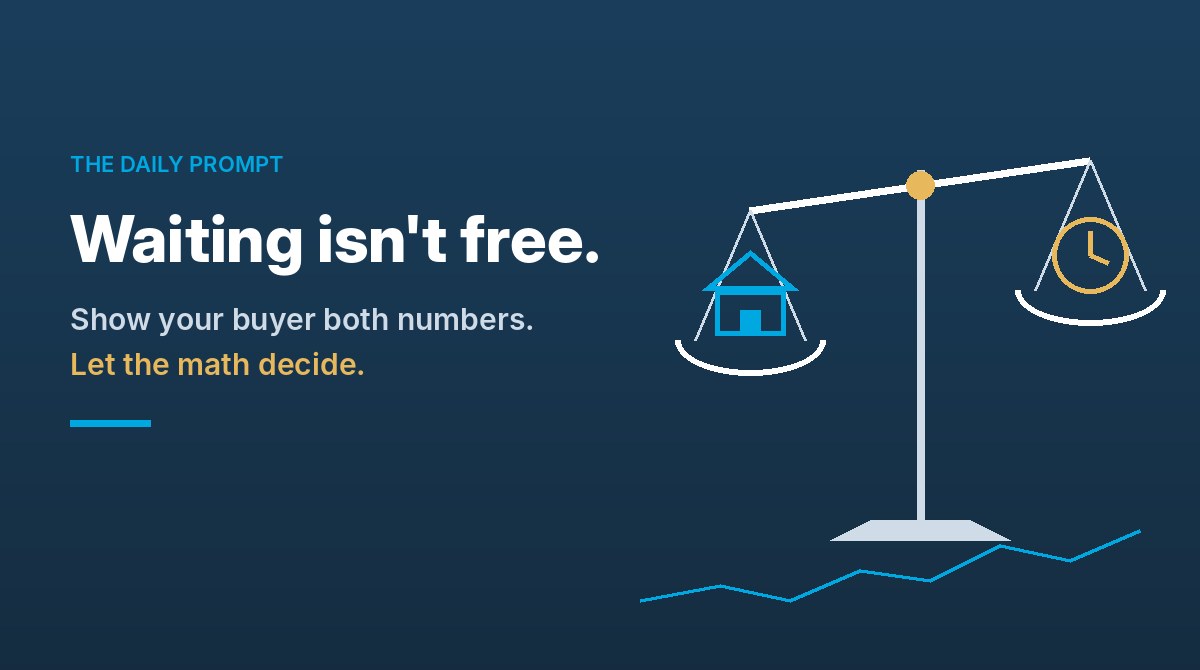
Answer “We’ll Wait for Rates to Come Down” With Your Client’s Own Arithmetic Instead of Your Opinion
Freddie Mac’s thirty-year average rose to 7.28 percent on November 19, from 7.11 percent a week earlier, and existing-home sales are at their slowest pace since 2010. Plenty of buyers have already decided to wait. The losing answer is a rate forecast. The winning answer is a side-by-side of the two choices they actually have, built only from figures they gave you.
Paste in the price, down payment, their lender’s quoted rate, taxes, insurance, dues, rent and the lower rate they’re waiting for. You get buy-now and wait tables with the math shown, the difference both ways, the break-even price, what the comparison can’t tell them, and three questions for their lender. Run it before the consultation, not during it.
You are helping a licensed real estate agent prepare a factual cost
comparison for a buyer who is considering waiting. You are not a
lender, a tax adviser or a forecaster. Use ONLY the figures I paste.
Invent nothing.

FIGURES I AM PASTING
  Target purchase price:                 [PASTE]
  Down payment amount or percent:        [PASTE]
  Quoted interest rate today, from the
  client's own lender (not an average):  [PASTE]
  Loan term in years:                    [PASTE]
  Annual property tax estimate:          [PASTE]
  Annual insurance estimate:             [PASTE]
  Monthly HOA or club dues, if any:      [PASTE]
  What the client is paying in rent now:  [PASTE]
  The lower rate the client says they
  are waiting for:                       [PASTE]
  What the client believes the price
  would be at that point, and why:       [PASTE]

PRODUCE, IN THIS ORDER

1. BUY NOW, AS QUOTED. Monthly principal and interest, then taxes,
   insurance and dues added, then the total. Show the arithmetic
   line by line so I can check every step. State the loan amount
   you used.

2. WAIT, ON THE CLIENT'S OWN ASSUMPTIONS. The same table, using
   the lower rate and the price the client named. Do not adjust
   either number. If the client gave no price for that scenario,
   write "[NOT PASTED]" and run it at today's price, labelled
   as such.

3. THE DIFFERENCE, BOTH WAYS. Monthly difference and difference
   over the full term, in dollars. Say plainly which scenario is
   cheaper on these numbers and by how much. If waiting is
   cheaper, say so in the first sentence.

4. THE BREAK-EVEN. Holding the client's lower rate fixed, the
   purchase price at which waiting and buying now produce the
   same monthly payment. One number, with the arithmetic.

5. WHAT THIS COMPARISON CANNOT TELL THEM. A short list. Include
   at minimum: that neither of us knows where rates go; that the
   rate in box three is a quote and not a lock; that tax and
   insurance figures are estimates until underwritten; that a
   refinance later is possible but its cost is unknown; and any
   figure I left blank.

6. THE THREE QUESTIONS FOR THEIR LENDER. Specific to these
   numbers, written so the client can read them aloud on a call.

RULES - FOLLOW EXACTLY
- Use only the pasted figures. No rate, price, tax rate,
  insurance cost, index or average from your own knowledge.
  Missing: write "[NOT PASTED]" and keep going.
- Do not predict, imply or hint at where rates, prices or
  inventory are heading. If asked, the answer is that nobody
  knows. Do not describe this moment as an opportunity, a window,
  a bottom, a top, or a good or bad time to buy.
- No urgency, no scarcity, no "before it's too late", no
  flattery, no closing summary, no call to action.
- Say nothing about the client's taxes, deductions, credit,
  qualification, estate or legal position. Those go to their
  lender, accountant or attorney, each named as such.
- Never describe, rank or recommend an area, building or
  community by the people in or near it. Say nothing about, and
  never infer from a name, address, school or anything else:
  race, colour, religion, national origin, sex, gender identity,
  sexual orientation, familial status, marital status, children,
  pregnancy, household composition, disability, age, source of
  income, immigration status or primary language. Use no stand-in
  for any of them - not "good schools", "safe", "quiet",
  "family-friendly", "exclusive", "up-and-coming", "desirable",
  "the right area for them", "young professionals", "empty
  nesters" or "retirement community". If a note I paste contains
  anything of that kind, leave it out and tell me which note you
  left out and why.
- Property, price, payment and market data only. Round to the
  nearest dollar and show every total you assert.

OUTPUT: the six parts, nothing before or after.
What good output looks like
Part three is the part that earns trust, and it has to be allowed to go against you: if the client’s own assumptions make waiting cheaper, the output says so first, and you are the agent who ran the honest numbers. Part four is where the conversation turns, because a break-even price is something a client can hold against a listing. Part five keeps the sheet out of trouble: it compares two assumptions, it does not predict anything, and it says so on its face.
AI Video for Realtors: Every AI Video Tool Worth Knowing

Live on Zoom, today, Friday, November 20, at 12:00 PM ET. Honest listing trailers from the photos you already have, a disclosed digital twin of you that films while you sell, and which of Higgsfield, Google Flow, Runway, HeyGen and Descript fits which job.
This page and its imagery were made with the assistance of artificial intelligence. Bogen.ai is operated by Dave T Productions, LLC · Privacy Policy