


The three-path map, the path comparison, and the choice record — prepared by Edmund Bogen
Walk into the listing appointment and beat the agent who only knows one path. Sellers are now being offered three ways to market a home: privately inside one brokerage, in a pre-market preview, or fully public on the MLS and the portals. In this session we build the seller's one-page map live, with AI prompts, from your own MLS, brokerage and portal rules. Then the side-by-side for this seller's goals, and the written record of what they chose and when you'll look again. Built on rules and studies verified October 2, 2026, with examples from Florida to Washington State.
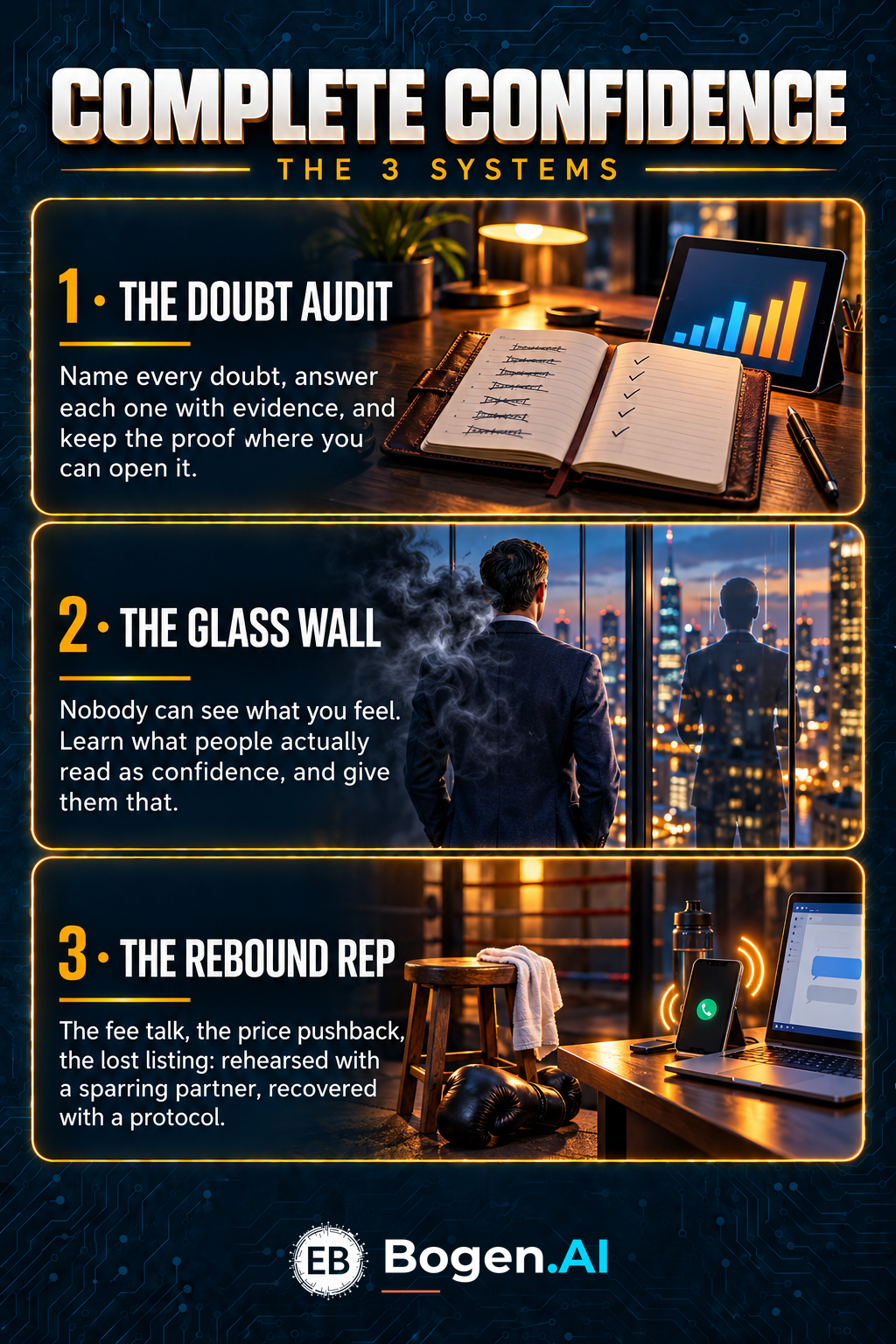
Most clients never interview a second agent. The first conversation is the interview, the fee conversation is now the moment agents say they find hardest, and the public image of the profession is at a low point. In that market, confidence wins the room and arrogance loses it the moment you are wrong. The difference between the two has a name: calibration. And the thing that makes calibrated confidence possible is the secret most agents never learn: nobody can see what you feel.
They see the confidence. Never the doubt. Here is how to build both halves.
We will master 3 systems live, together:
1️⃣ The Doubt Audit — name every doubt, answer each one with evidence, and keep the proof where you can open it in the room
2️⃣ The Glass Wall — nobody can see what you feel. Learn what people actually read as confidence, give them that, and keep it calibrated so it never tips into arrogance
3️⃣ The Rebound Rep — the fee talk, the price pushback, the lost listing and the cold call, rehearsed with an AI sparring partner and recovered from with a written protocol
Register for the SessionConfidence against calibration, ten verified findings, and the words agents actually use
| Low calibration | High calibration | |
|---|---|---|
| High displayed confidence | Arrogant. Sounds sure, often wrong. Trusted until the first exposed mistake; then credibility collapses. Status by dominance. | Complete confidence. Sure where the evidence is, precise where it isn't, shares credit, says "here's how I'll find out." Status by earned respect. |
| Low displayed confidence | Lost. Unsure and unprepared. Most first-year agents start here. The fix is evidence, not attitude. | Invisible. Knows the market cold, hedges every sentence. Loses listings to louder agents who know less. |
From Lost to Complete Confidence is not a straight line up. Agents who only raise displayed confidence end up Arrogant: trusted for a while, then quietly dropped after the first exposed mistake. The path runs through evidence first (System 1), then signal (System 2), with pressure reps (System 3) to keep you there. That is why the doubt audit comes before anything about posture or voice.
| Moment | Arrogant | Invisible | Complete confidence |
|---|---|---|---|
| Pricing | "Trust me, I know this market." | "I mean, it's hard to say, maybe around…" | "The last six sales here went pending in 19 days at a median of 97% of list. Here they are." |
| The fee | "I don't negotiate my commission." | "I can probably do something on the fee if that helps." | "Here's what the fee buys, line by line, and here's what it produced on my last ten listings." |
| A question you can't answer | Bluffs an answer. | "Sorry, I'm not sure." | "That's an open question in this market. I'll have the answer from the lender by Thursday." |
| Another agent's claim | "That agent is lying to you." | "Well, they might be right." | "I've seen that study too. Here's what it counted, and here's what our MLS shows." |
| After a loss | "They made a mistake." | "I'm just not good at this." | "[Your name], the price conversation came too late. Next time it opens the meeting." |
THE RULE THAT RUNS THIS WORKBOOK
Confidence without calibration is a credibility time bomb. People reward confident advisors until the advisor is caught wrong; then the confident one loses more than the careful one would have. Build the evidence first, so the confidence is earned.
Ten findings that survived verification, each with what it means in a listing appointment.
| Finding | What it means on a listing appointment | Source |
|---|---|---|
| Observers judge competence from how much you contribute, a confident factual tone, relevant information, a calm demeanor, and answering first. They ignore explicit claims about yourself. | Bring the data and speak to it plainly. "I'm the best in the area" does nothing; "the last six sales on this street went pending in under three weeks" does everything. | Anderson, Brion, Moore and Kennedy, JPSP 2012, six studies |
| Confidence raises credibility only for accurate advisors. Confident but inaccurate advisors receive low credibility once the error shows. | Say "I know" only where you do. The price you quote with certainty is the one that will be checked. | Sah, Moore and MacCoun, OBHDP 2013; Tenney, Spellman and MacCoun, JESP 2008 |
| Groups did not punish people revealed as overconfident. The cost shows up as lost credibility, not lost status. | Don't expect arrogant competitors to "get found out." The client stops believing them quietly, and the same would happen to you. | Kennedy, Anderson and Moore, OBHDP 2013 |
| "It is uncertain" costs less perceived competence than "I am uncertain." | "Rates are the open question this month" beats "I'm not sure about rates." Then say how you'll track it. | Løhre and Teigen, QJEP 2023, five studies |
| Expressed humility (admitting limits, crediting others, teachability) predicts performance and engagement. | Credit the stager, the lender, the last agent. Name what you'll check. It reads as strength. | Owens, Johnson and Mitchell, Organization Science 2013 |
| Self-esteem comes from a striving for growth; narcissism from a striving for superiority. | The arrogance test: are you trying to be better than last month, or better than the other agent? | Brummelman, Thomaes and Sedikides, Current Directions 2016 |
| Mastery experiences are the strongest source of self-efficacy. Action first, feeling second. | Confidence is built in reps and logged wins, not affirmations. | Bandura, Psychological Review 1977; Harris, The Confidence Gap 2011 |
| Talking to yourself by name improved rated speech performance and reduced distress across seven studies. | The pre-appointment reset and the post-loss debrief both use it. | Kross et al., JPSP 2014, N = 585 |
| Five filler sounds a minute did not hurt ratings; twelve a minute lowered perceived confidence and preparedness. | Count "um" in a recorded call. Below five, stop worrying. Above ten, fix it. | Laske and DiGennaro Reed, JABA 2024 |
| If-then plans raise goal attainment with a medium-to-large effect across 94 tests. | "If the seller says the discount broker charges 1%, then I open the proof ledger." | Gollwitzer and Sheeran 2006, d = 0.65 |
Verified October 2, 2026. Each is a published study; the single-study findings are labeled as such on page 19, and none is presented as settled law.
The first conversation is the interview, the fee is the pressure test, and trust is at a low point
| Measure | Figure | Source |
|---|---|---|
| Sellers who contacted only one agent | 80%. Buyers: 76% of repeat buyers, 67% of first-time buyers interviewed only one. | NAR 2025 Profile of Home Buyers and Sellers, Nov 4, 2025 |
| Hired the first agent they spoke with | 59% of sellers, 47% of buyers | Zillow Consumer Housing Trends Report, Dec 30, 2025 |
| What decided it for sellers | Reputation 35%, honest and trustworthy 22%, friend or family 15%, neighborhood knowledge 11%. Commission: 4%. | NAR 2025 Profile |
| Agents' biggest strain since the settlement | Buyer-side compensation 34%, negotiating with sellers 30% | Cotality and ResiClub survey, n = 213, Mar 24, 2026 |
| Sellers who negotiated the commission | 33%. Of those who asked, 93% got a reduction. | Clever poll of 500 sellers, Real Estate News, Aug 26, 2026 |
| Seller trust in agents | 70%, down from 81% a year earlier | Clever Real Estate seller survey, Apr 9, 2025 |
| Agents with two years or less | Median gross income $8,000; 0% repeat or referral business; 15% of all members | NAR 2026 Member Profile, Jun 25, 2026 |
The industry legend to retire: "87% of agents fail in five years." Nobody can source it, and NAR does not measure it. What the data do show is harder and more useful: agents with two years or less earn a median of $8,000 with no repeat business. The gap is confidence built on evidence, and that is buildable.
The illusion of transparency, and what people actually read as confidence
People consistently overestimate how much their internal states show: their nerves, their uncertainty, the lie they just told. Gilovich, Savitsky and Medvec named it the illusion of transparency in 1998 (JPSP). In a related line of work, the spotlight effect, people also overestimate how much others notice their appearance and slips at all (Gilovich, Medvec and Savitsky, JPSP 2000).
The finding that matters most for an agent came five years later. Savitsky and Gilovich (2003, Journal of Experimental Social Psychology) had people give speeches in three groups: no instructions, reassurance that nerves are normal, and a group simply taught about the illusion of transparency. The informed group rated themselves higher and, more to the point, independent observers rated their speeches higher in quality and lower in visible anxiety. Knowing that the audience cannot see your nerves changed what the audience saw.
THE SECRET, IN ONE SENTENCE
They see the confidence. Never the doubt. Your racing heart, the sentence you are unsure of, the listing you lost last week: none of it is visible. What is visible is what you contribute, how plainly you state it, and whether you stay calm. Give them that.
| What people actually read | What it looks like on you | What it is not |
|---|---|---|
| Contribution | You bring the data, the comps, the plan. You speak to each one. | Talking the most |
| A factual tone | Short declarative sentences about things you can show. | Volume, superlatives, "trust me" |
| Relevant information | The six sales on this street, not the national headline. | Your résumé |
| A calm demeanor | Pauses. Falling intonation at the end of a sentence. Under five fillers a minute. | Stillness as a pose |
| Answering first | A clear first sentence, then the evidence. | Interrupting |
| Calibration | "I know", "I expect", "that's the open question" used correctly. | Certainty about everything |
Two things that help, and one that doesn't. Talking to yourself by name before a meeting ("[Name], you know this street") improved rated performance and reduced distress across seven studies (Kross et al., 2014). Standing tall helps because slouching costs you, not because posture changes your hormones; that part failed replication. And "fake it till you make it" is not supported: the defensible version is act first, feel second.
Turn vague doubt into testable sentences and answer each with evidence
| Column | What goes in it | Example |
|---|---|---|
| The doubt, as a testable sentence | Not "I'm bad at this" but one specific claim | "I can't justify my fee when a seller quotes a 1% broker" |
| What would settle it | EVIDENCE I have · EVIDENCE I need · a SKILL to practice · a FEAR with no factual answer | EVIDENCE I need: what my last ten listings produced against the market |
| The evidence | A number, a quote, a dated event from the proof ledger | "Median 19 days to contract against 31 for the area; 97% of list against 95%" |
| Status | OPEN · IN PROGRESS · SETTLED (with the date) | SETTLED Oct 23 |
| Source | What it is | Where this system gets it |
|---|---|---|
| Mastery experiences | Things you did. The strongest source by far. | The Friday win deposit (1.4); the sparring reps (3.1) |
| Evidence from others | What clients and agents said, quoted exactly | The proof ledger (1.2) |
| Knowledge you can recite | Every recent sale on the street, from memory | The territory quiz (1.3) |
| Physiology | Sleep and exercise. Sleep loss makes people more confident and no more accurate. | Guardrails, page 17 |
THE RULE THAT RUNS THIS SYSTEM
Answer doubts with evidence, not affirmations. "Knowledge always brings confidence, and ignorance always brings fear" (Mike Ferry, 2024). "Nothing accelerates credibility faster than proof" (Glennda Baker, 2025). The ledger is the proof.
Paste your own words and your own numbers. Never let the AI invent a sale, a quote or a reassurance.
I'm a real estate agent in [MARKET] with [X] years in the business. Here are the moments I lose confidence, in my own words [PASTE: for example the fee conversation, pricing pushback, cold calls, being on camera, the week after losing a listing], and the doubts behind them [PASTE]. Turn this into a doubt inventory: one row per doubt, rewritten as a specific, testable sentence (not "I'm bad at this" but "I can't justify my fee when a seller quotes a 1% broker"). For each row, classify what would settle it: EVIDENCE I already have, EVIDENCE I need to gather, a SKILL to practice, or a FEAR with no factual answer. Do not reassure me and do not write affirmations. End with the three doubts that would change my income most if they were settled.
Here are my closed transactions from the last [12] months, with list date, list price, final price, days to contract, property type and neighborhood [PASTE]. Here are the market medians for the same period and area from my MLS [PASTE, with source and date]. Build a one-page proof ledger: for each measure, my number next to the market number, stated as a plain fact. Then write five sentences I can say to a seller that use only these numbers, no adjectives, no comparisons to other agents by name. Mark any claim I could not back up with the pasted data as DO NOT SAY. Do not round in my favor.
Knowledge you can recite, and a win logged every week.
Here is an MLS export of every sale and active listing in [FARM OR AREA] over the last [12] months [PASTE]. Build a 10-question quiz I can take on my phone: address-level questions (what did a given home sell for, how many days did it take), pattern questions (median days to contract this quarter against last quarter), and three "what would you say" questions a seller on that street might ask. Give the answers at the end with the source row for each. Next week I will paste the updated export and ask for a new set. Never invent a sale that is not in the export.
It's Friday. Here is what happened this week [PASTE: calls made, appointments, offers, feedback received, anything that went well or taught me something]. Write three dated one-line entries for my proof ledger: one mastery experience (something I did this week that I could not do a year ago), one piece of evidence a client or agent gave me (quote it exactly), and one number. Plain facts, no adjectives, no praise. Then tell me which doubt from my inventory [PASTE] this week's entries speak to, if any, and whether it can now be marked SETTLED.
Calibrate every sentence, audit how you sound, and share credit without losing the room
| Tag | What it means | How it sounds |
|---|---|---|
| KNOW | The data is in hand and you can cite it | "The last six sales on this street went pending in under three weeks." |
| ESTIMATE | A reasonable inference; say from what | "Based on those six, I expect three to four weeks if we price with them." |
| UNKNOWN | Nobody can know yet; state it as a fact about the market, then say how you'll track it | "Where rates land in November is the open question. I'll send you the lender's read every Friday." |
Here is my listing presentation, word for word [PASTE]. Tag every factual claim as KNOW (I have the data in hand: cite it), ESTIMATE (a reasonable inference: say from what), or UNKNOWN (nobody can know this yet). Rewrite the presentation so the language matches the tag: plain, certain sentences for KNOW; "based on X, I expect Y" for ESTIMATE; for UNKNOWN, state it as a fact about the market, not about me, and add one sentence on how I will track it. Remove every superlative about myself and every comparison to another agent. Keep my voice. Then list the three places where I sounded most sure with the least evidence.
THE LINE THAT KEEPS YOU ON THE RIGHT SIDE OF THE WALL
"Here's what I know, here's what I expect, and here's the one thing nobody can know yet. I'll track that one for you." Sure where the evidence is, precise where it isn't. That sentence is the whole difference between confidence and arrogance.
A recording tells the truth about how you sound. The credit lines are how you share credit and admit limits without losing the room.
Here is a transcript of a call or meeting I recorded with the other party's consent [PASTE], and its length in minutes [X]. Count: filler sounds and words per minute (um, uh, like, you know); hedges ("kind of", "I think maybe", "sort of"); superlatives about myself; comparisons to other agents; times I interrupted; and questions I asked. Flag the three arrogance markers: talking over the client, a claim with no evidence attached, and running down another agent or company. Flag the three invisibility markers: hedging a fact I actually know, apologizing for taking their time, and answering a question I wasn't asked. Give me a one-page scorecard and rewrite my three weakest sentences. Judge the transcript, not my personality.
Write ten sentences I can use in listing appointments and client meetings that share credit or admit a limit without losing authority. Shapes to use: crediting the stager, the lender or the previous agent by role; saying exactly what I will verify and by when; naming what I got wrong last time and what changed; stating an unknown as a fact about the market rather than about me. Each under 20 words, spoken language, no self-deprecation, no "I'm just". Then write the two sentences I should never say in those moments, with the reason for each.
The camera is the purest test of the glass wall: you feel everything, and the viewer sees only what you give them.
I'm going to record a two-minute, unscripted video for one specific person [NAME, who they are, what they are dealing with]. Give me a four-beat outline I can glance at, not a script: why I'm sending this to them, one specific thing I noticed about their situation, one piece of evidence from my proof ledger [PASTE], and one next step. Then three reminders for delivery: speak to the person, not to an audience; end sentences on a falling note; stop when the point is made. Do not write dialogue.
| What you feel | What they see |
|---|---|
| Your heart rate | A man or woman who paused before answering |
| The sentence you're unsure of | A sentence stated as an estimate, with its basis |
| Last week's lost listing | Nothing. It isn't in the room unless you bring it |
| "I have no idea what rates will do" | "That's the open question. Here's how I'll track it for you." |
| The urge to prove yourself | Credit given to the stager, the lender, the last agent. It reads as strength |
On camera specifically: the "ick" people feel watching their own videos comes from reading or remembering lines, which activates a different part of the brain than talking to someone. Chelsea Peitz's fix, and ours: two unscripted minutes, addressed to one named person. Focusing on them reduces self-consciousness, and the viewer sees only the person talking to them.
The fee talk, the price pushback, the lost listing and the cold call, rehearsed and recovered
| Pressure moment | What usually happens | What the research says to do |
|---|---|---|
| The fee conversation | You over-explain, drop the fee before they ask, or dig in. | Open the proof ledger. State what the fee buys and what it produced. Calibrated, specific, short. |
| Price pushback | You defend the number instead of showing it. | Evidence first, then the options. Never "the market is telling us." |
| The lost listing | Replaying it for a week, or blaming the seller. | The third-person debrief within 24 hours. One rep for next time. Then stop. |
| The cold call | Avoidance dressed up as busy. | The rejection count. Each no is a data point. Daily reps beat occasional courage. |
Play a skeptical seller in [MARKET] who is considering listing a [PROPERTY TYPE, PRICE RANGE] with me. Run one moment at a time, in this order unless I say otherwise: (1) "A discount broker will do it for 1%." (2) "Zillow says my house is worth more than your number." (3) "We're going to go with the other agent." (4) a cold call, where I am the one calling you. Stay in character and push back twice on each. Then stop and score me on four things: calibration (did I claim only what I could back up), composure (pace, no over-explaining), evidence (did I use my proof ledger [PASTE]), and warmth (did I acknowledge you before answering). Give one sentence on what to do differently, then start the next moment. Never score me on whether I "won".
ALREADY IN YOUR LIBRARY
Need a full mock listing appointment or a seller roleplay? Those exist: The Seller Roleplay (The AI Pricing Story), The Objection Gym (My Client Asked ChatGPT), and Mock Listing Appointments with ChatGPT. The sparring partner here is narrower on purpose: four pressure moments, scored on calibration and composure.
Decide the move before the moment. Debrief in the third person. Count the no's.
Here are my four pressure moments and what tends to happen in each [PASTE]. Write one implementation intention per moment in the exact form "If [the specific trigger], then I [one concrete action]", where the action is something from my proof ledger, my credit lines, or a question I ask. Keep each under 25 words. Then give me a pocket-card version: all four on one line each, so I can read them in the car before the appointment.
I just lost [a listing / a client / a deal]. Here is what happened, in my words [PASTE]. Rewrite it as a short debrief addressed to me by name, in the third person ("[NAME], here's what happened…"): what was in my control, what wasn't, the one thing I'd do differently, and the one rep to practice this week. Four short paragraphs. No consolation, no blame, no "everything happens for a reason". End with one dated line for my proof ledger if anything in this loss belongs there.
Here is my log of asks for the week: calls, appointment requests, listing presentations, fee conversations, with the outcome of each [PASTE]. Count the asks and the no's and give me the ratio, compared with last week [PASTE]. Tell me which no's came with a reason and which were silence. Write a two-line summary I can read on Monday morning that treats each no as a count, not a verdict, and name the one ask I avoided this week.
Where each prompt fits, from the first doubt inventory to the Friday after a loss
| Stage | Prompts | What changes |
|---|---|---|
| Week 1 | 1.1 doubt inventory · 1.2 proof ledger | Vague doubt becomes a list; the list meets the numbers |
| Before an appointment | 2.1 calibration rewrite · 1.3 territory quiz · 3.2 pocket card | Every sentence matches its evidence; the street is in memory; the moves are decided |
| In the room | The glass wall card · the credit lines (2.3) | They see contribution, a factual tone, calm. Not the nerves |
| After the room | 2.2 transcript audit (with consent) | The recording, not the feeling, tells you how you sounded |
| After a loss | 3.3 third-person debrief within 24 hours | What was in your control, one rep, then stop |
| Every Friday | 1.4 win deposit · 3.4 rejection count | A mastery experience logged; each no counted, not judged |
| Every week | 3.1 sparring partner · 2.4 camera rep | The reps that make the moments familiar |
THE PROMISE
No doubt of mine goes unanswered. No sentence of mine outruns its evidence. And no client of mine ever sees the doubt, because there is nothing there to see but the proof.
This session builds on earlier workbooks instead of repeating them
| When you need… | Use this | From the workbook |
|---|---|---|
| Your authentic voice on paper and on camera | The Voice Print; The Slop Filter | Own Your Voice (Sep 2, 2026) |
| Positioning as the market authority in one niche | The niche claim and the farm plan | Death of the Generalist (Sep 9, 2026) |
| The pricing conversation itself, with the numbers | The Five-Act Pricing Story; The Seller Roleplay | The AI Pricing Story (Jul 29, 2026) |
| A seller who repeats something an AI or another agent told them | The Local Truth Layer; The Objection Gym | My Client Asked ChatGPT (Aug 26, 2026) |
| The price-reduction meeting, minute by minute | The 30-minute decision meeting; Prompt 2.5 — The Emotion-First Opener | The Price-Cut Conversation (Oct 14, 2026) |
| Knowing the seller before you walk in | The Seller Brief Builder | The 7-Touch Pre-Listing Sequence (Aug 5, 2026) |
| Keeping client details out of AI, and the paper trail | The Data Line; The Compliance Workflow | Keeping AI Compliant (Sep 23, 2026) |
| Rehearsing a full listing appointment with AI | Mock listing appointments | Mock Listing Appointments with ChatGPT (Dec 3, 2025) |
| Focus, discipline and daily routines | The flow-state and discipline systems | Illegal Focus Domination (Nov 5, 2025); AI-Powered Discipline Revolution (Jul 23, 2025) |
| Difficult clients and difficult deals | The defense system | The Difficult Client Defense System (Oct 15, 2025); Difficult Deals (Jan 28, 2026) |
The doubt inventory · the proof ledger · the territory quiz · the Friday win deposit · the glass wall (the illusion of transparency, taught) · the calibration rewrite · the transcript audit · the credit lines · the camera rep · the sparring partner scored on calibration and composure · the if-then pocket card · the third-person debrief · the rejection count.
The lines the research corrected, and the rules that keep the practice safe
| The popular line | What the evidence says | Say instead |
|---|---|---|
| "Two minutes of power posing changes your hormones." | Only the feeling of power replicated; no hormone or performance effects (Ranehill 2015; Körner 2022, 88 studies). A co-author disavowed the original in 2016. | "Slouching costs you. Stand tall because it's cheap, not because it's magic." |
| "87% of agents fail in five years." | No source exists. NAR does not measure it. | "Agents with two years or less earn a median of $8,000. That gap is buildable." |
| "The least competent are the most confident." | The classic Dunning-Kruger graph is largely a statistical artifact. | "People are poor judges of their own skill. Measure it." |
| "10,000 hours makes an expert." | Not the researcher's claim; practice explains under 1% of performance variance in professions. | "Structured practice with feedback." |
| "Fake it till you make it." | Rests on failed replications. Harris: you can't fake confidence, you earn it. | "Act first. The feeling follows." |
| "70% of people have imposter syndrome." | The systematic review's range is 9% to 82% depending on the instrument; no treatment trials exist. | "It's common, and it's not a diagnosis. Answer the doubt with evidence." |
| "Confidence comes from competence." (as Tom Ferry) | Not found on his site. His verified line: "confidence comes from experience." | Quote the verified line. |
Where confidence ends. If the doubt is bigger than a listing appointment, if it is costing you sleep or showing up as dread most days, that is not a workbook problem. Talk to a professional. This session is practice for the job, and nothing in it replaces that.
Audit the doubt, learn the wall, spar, then make it the weekly default
| Week | Actions |
|---|---|
| Week 1 — Audit the doubt | Run Prompt 1.1 and keep the three doubts that matter most · Pull your closed transactions and the market medians; build the proof ledger (1.2) · Save all 12 prompts in your prompt library |
| Week 2 — Learn the wall | Record one call with consent and run the transcript audit (2.2) · Run the calibration rewrite (2.1) on your listing presentation · Write your ten credit lines (2.3) and say three of them out loud this week |
| Week 3 — Spar | Run the sparring partner (3.1) through all four moments, twice · Write the if-then pocket card (3.2) and keep it in the car · Send one two-minute video to one person (2.4) |
| Week 4 — Make it default | Friday win deposit (1.4) on the calendar, every week · Territory quiz (1.3) every Monday from the fresh export · After any loss: the third-person debrief (3.3) within 24 hours; the rejection count (3.4) every Friday |
THE PROMISE
Doubts answered with evidence. Confidence read the way I intend. A rep done before the moment arrives.
All 12 prompts, the worksheets, the verified rules pages, and every source — in one PDF
The complete workbook includes the three paths in the rule-makers' words, the portal and brokerage policies, the MLS and state comparison, the studies page, the rule-sheet and seller-map prompts, the path comparison worksheet, the claim check, the four path questions, the review agreement, the guardrails, and the 30-day plan.
Download the Workbook (PDF)Verified October 2, 2026 — these rules are changing month to month, so confirm the current version with your MLS and broker before a seller meeting
Educational resource: It is not therapy, not medical advice and not legal advice. Record calls only with the consent your state requires. AI output must be checked against your own records, and the proof ledger must contain only numbers you can show. Always follow your broker's policies, your MLS rules and fair housing law.